
 Under each article, you have the opportunity to write a comment. Please use this feature that our Webmaster, Bruce Scherzinger, worked so hard to bring back. We are so pleased to welcome Ryan Vicino, from the Class of 2020, as a contributing author to Hixnews! We hope you enjoy his article! We continue to need writers and a successor Webmaster with CMS experience to ensure that HixNews is here for generations to come. Please email us at
View The Hix News Team
Thomas Connolly - '74, Financial Conversations
Joseph Platt - '64
John Maniec - '64
Webmasters:
Web Development and IT:
Editors Emeritus:
David J. Rubin - '82
Elliot Gorlin - '63
Valerie Pakaluk - '51
Henry Lichtenstein - '59
Marc Malamud - '77
Founding Editors:
Pat (Koziuk) Driscoll - '56
Linda (Piccerelli) Hayden - '60
Buffalo Bob Casale - '61
Founding Webmaster:
Roger Whitaker
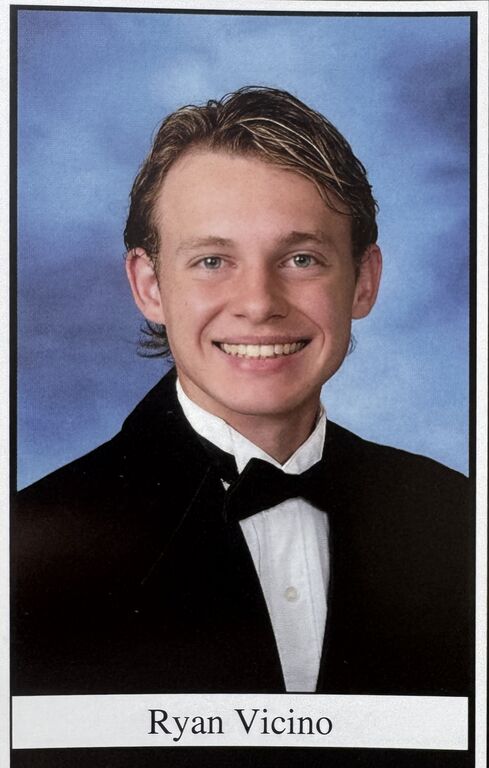 by Ryan Vicino, Class of 2020
Richard Allan Kasso Jr., known as “Ricky” to close friends and family, was a Long Island local born in Huntington on March 29, 1967. Described as a troubled teenager, Richard would often be found in the town of Northport throughout his youth as a drugged-up young man who survived living in the streets with a local marijuana dealer group known as the “Knights of the Black Circle”, despite his father's role as a local football coach at Cold Spring Harbor High School. Richard had left his home for a rougher life at around the age of 15, despite both parents attempting to admit him into psychiatric care and drug rehabilitation.
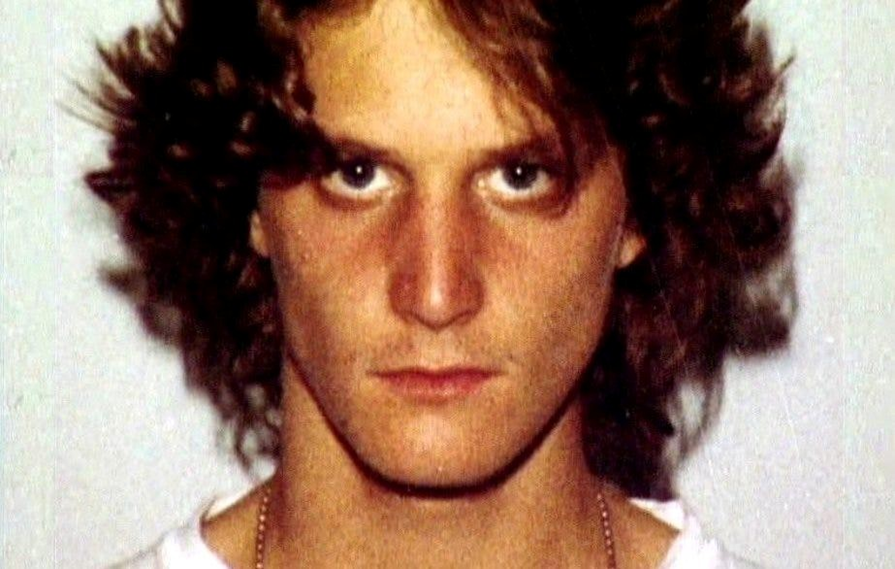 Richard Allan Kasso Jr. (Courtesy of SCPD)
Roughly two years after this decision, Richard Kasso Jr. would go on to murder his 17-year-old friend, Gary Lauwers, over claims of him stealing Richard’s PCP. Richard had lured Gary Lauwers into the nearby Azatakea Woods in order to get high, along with friends Jimmy Troiano and Albert Quiñones. However, this small “party” would soon take a turn for the worse, as Richard confronted Gary Lauwers about the suspected PCP he had stolen at an earlier date. Upon this confrontation, Richard would assault Gary, beating him, biting him, and eventually stabbing him up to a total of 36 times, leading to Gary’s death.
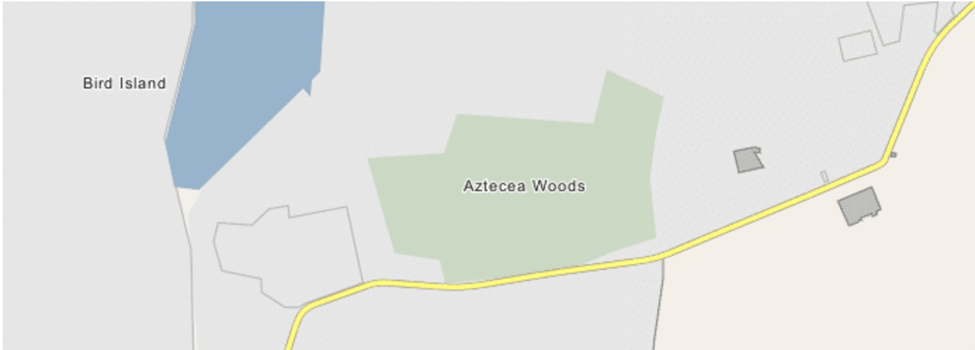 Former Site of Aztecea Woods (Wikimapia, 2010)
Friend Albert Quiñones would later go on to state that Jimmy Troiano also helped with the murder, but he was never convicted of this crime. Ricky Kasso would eventually be arrested for the murder on July 5, 1984, and would be arraigned on July 6th. Throughout the trial, it would be discovered that Richard Kasso reportedly told Gary Lauwers to “Say you love Satan”. It was also uncovered that Richard had bragged about the murder to his friends, saying he saw a vision of Satan soon after the murder, assuring his approval of the act. He would even go on to show fellow teenagers of the local area the makeshift burial ground of Gary Lauwers, until moving the body with Troiano into a nearby shallow grave. One day after his arraignment, Richard Allan Kasso Jr. would commit suicide by hanging within his own jail cell. Since the public caught wind of Ricky’s story, there has been a major impact on pop culture and social media.
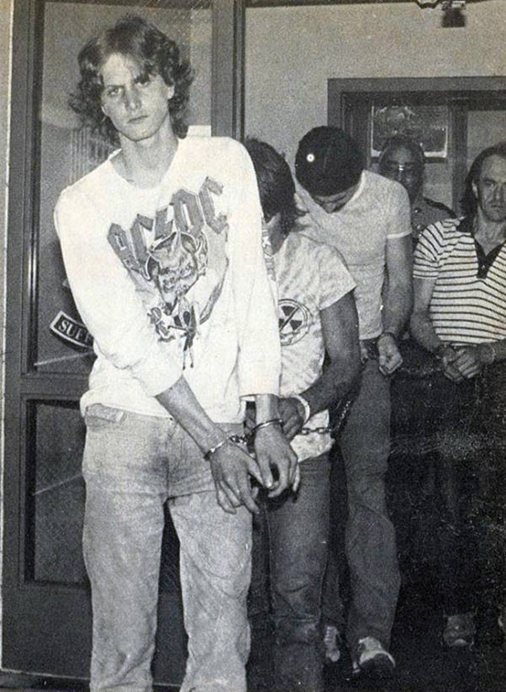 Richard Kasso Jr. and Jimmy Troiano on the day of their arrest. “Ricky” is seen in a white AC/DC shirt.
(Public Domain, SCPD)Initially, the murder case of Gary Lauwers would play a major role in influencing the media’s perception of rising youth activities, such as listening to emerging music genres like heavy metal. When Richard was arrested on July 5, 1984, initial arrest photographs shown to the public portrayed 17 year old “Ricky” sporting a white, long-sleeve shirt donning an AC/DC logo across the front.
Due to these photographs, many local media outlets would rush in to use these as evidence of a rising “Satanic Panic” occurring across the United States. The “Satanic Panic” was a widespread belief throughout the 1980s and early 1990s that youth culture was driving young men and women to join Satanic cults and participate in illegal or illicit activities. Media outlets would further harp on this ideology by making false claims to the public that the "Knights of the Black Circle” drug dealer group Richard was a part of was a cult itself, supporting him in the murder of Gary Lauwers. Press would later go on to give Richard Kasso the nickname of “Acid King”, in a pure attempt to further incite panic in local suburban areas that the youth was organizing Satanic cults in their neighborhoods. Relevant papers today, such as The New York Post, The New York Times, and Rolling Stone had even published their own independent articles on Richard Kasso Jr. and the murder case throughout the 1980s.
While it is hard to see any outcome of this murder case as anything short of tragic, it is also important to take note of the media history that was produced prior to the “Satanic Panic”, specifically from the turn of the new millennium.
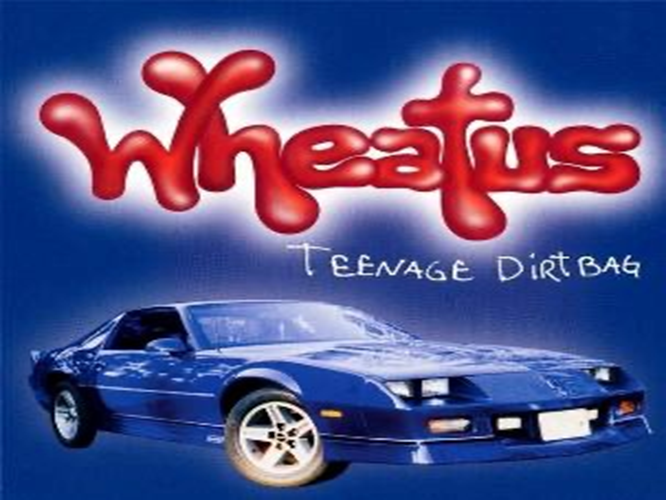 Wheatus’ “Teenage Dirtbag”, inspired by Richard Kasso Jr.’s story (Wheatus, 2000)In the summer of 2000, alternative rock band Wheatus released their first hit single, titled “Teenage Dirtbag”, as the lead single for their debut album “Wheatus”.
Garnering global success, the song soon ranked No. 1 in Australia that year and reached No. 7 on the Modern Rock Tracks chart. However, not many listening to their favorite song of the summer knew that the true inspiration of this track stemmed from the case of Gary Lauwers' murder. Singer, guitarist, and songwriter for the band Wheatus, Brendan B. Brown was 10 years old at the time of the murder, and lived on the same block as Richard Allan Kasso Jr. throughout his childhood. In a 2024 interview with VICE News, Brown would reveal that he had read Rolling Stone’s article on the case soon after Richard’s arrest, which specifically referred to the troubled teenager as a “dirt-bag”. With the resulting rise of the “Satanic Panic” movement, Brown stated that he found himself in a rough spot throughout his childhood, being someone who enjoyed listening to artists such as AC/DC, the same band that was photographed on Richard’s shirt on the day of his arrest. While this is the most prominent example of musical history inspired by this case throughout the 2000s, there are numerous other tracks with similar origin stories. Examples include Aesop Rock’s “Catacomb Kids” (2007), Nü Sensae’s “Cat’s Cradle” (2010), and Malibu Ken’s “Acid King”(2018). It is clear that the story of Richard Kasso has had an enduring impact on the media produced today.
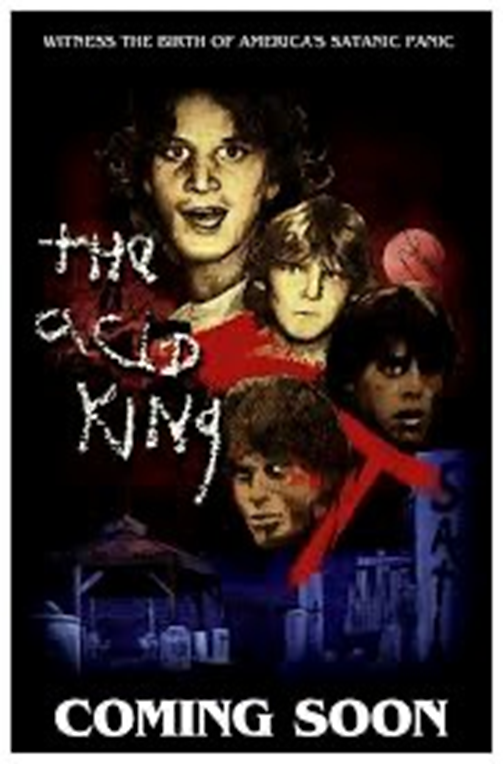 Advertisement Poster for Netflix’s 2019 film “The Acid King”
(Courtesy of Netflix)Remnants of media inspiration stemming from this story can still be found today. As recently as 2019, popular streaming service Netflix published a documentary titled “The Acid King”, even including Wheatus member Brendan B. Brown in a portion of the film. These sources of media history help entrench the story of Richard Allan Kasso Jr. into the past, providing us with a more “light-hearted” insight to the saddening murder of Gary Lauwers and the resulting “Satanic Panic” movement across the country. Without these sources of history, it would be very difficult for many current Long Island residents to be able to fathom the possibility of a homeless teenager on the streets of Northport causing a national outburst against youth culture.
 Wendy Elkis Class of 1977As we approach the 250th anniversary of the British Colonies declaring independence, this next to last article starts as a recap of important events and then leads us to Philadelphia, where the delegates of each colonial assembly met to discuss their dissatisfaction and eventual break with Great Britain.
The Ramifications of a War
The French Indian War ended in 1763. The Proclamation of 1763, a boundary line in the Appalachian Mountains, barred the colonists from settling on those Western lands won from the French in the French Indian War. Parliament thought that settling the Western lands could cause violence from Native Americans, as well as French settlers. The British also thought that if Western lands were settled and farmed, it could cause the Colonists to farm the land,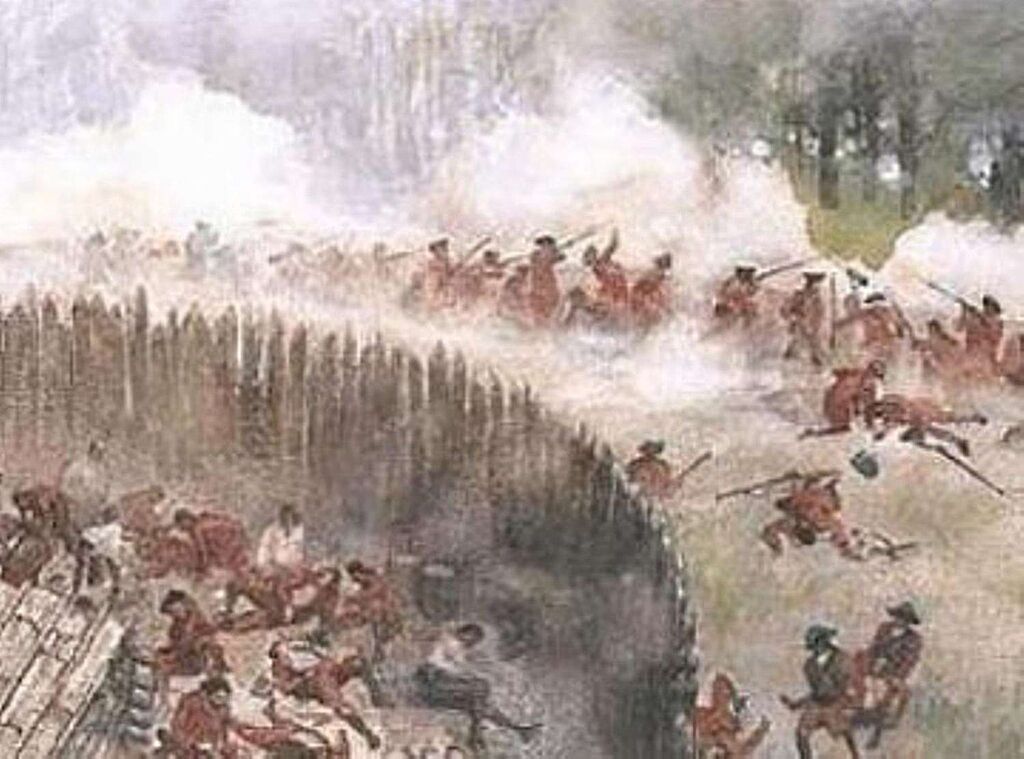 Fort Necessity thus leading the colonies to economic independence. Colonists who were eager to do so, settled the Western lands anyway without any interference from the government. A confederacy of Native people viewed this encroachment as a threat to their culture and political autonomy.
Starting in 1764, Parliament began to tax the colonies to decrease the debt they accrued from their war with the French. The first acts passed were the Sugar Act, which increased duties on non-English goods and the Currency Act, which prohibited the colonies 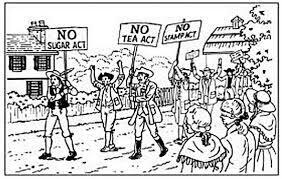 Protesting Taxesfrom issuing their own currency. This brought protests in Massachusetts and the cry of, “No Taxation without Representation,” since colonists weren’t represented in Parliament. This was also the start of the colonists’ refusal to use British goods.
1765 brought about the Stamp Act and the first Quartering Act. The Stamp Act was a tax on newspapers, almanacs, pamphlets, broadsides (posters), legal documents, dice, and playing cards. The Quartering Act required the colonies to provide housing in the form of barracks and supplies for British soldiers. These Acts brought about protests, as well as the formation of the group,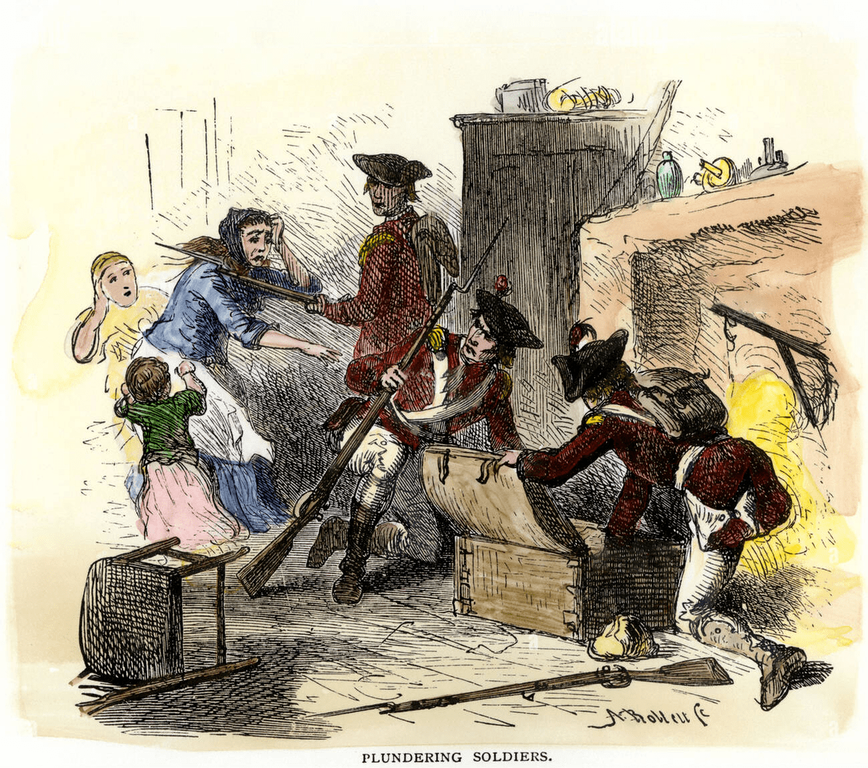 British Soldiers Entering a Home “The Sons of Liberty.” John Dickinson, a delegate from Delaware/Pennsylvania, wrote about the Stamp Act in his Letters from a Farmer in Pennsylvania. Dickinson felt that “the levying of money to raise revenue is avowed and exerted.” It appeared unconstitutional to him. Parliament was making the colonists pay for “defending, protecting, and securing the conquered provinces of Canada and Florida, and the British garrisons of Nova Scotia.” None of these were conquered for the colonies, nor did they benefit them. John Dickinson thought that it was an injustice to pay for these places.
The Stamp Act Congress passed a declaration of “Rights and Grievances” claiming that the colonists had the same rights as British citizens and therefore could not be taxed without representation in Parliament.
Speaking Up!
The Stamp Act Congress, held in New York City from October 7 to October 25, 1765, passed a declaration of “Rights and Grievances” claiming that the colonists had the same rights as British citizens and therefore could not be taxed without representation in Parliament. It made the following pronouncements:
- Colonists owe “the same allegiance” to the crown as those owed by “subjects born within the realm.”
- Colonists owe Parliament "all due subordination."
- Colonists possessed all the rights of Englishmen.
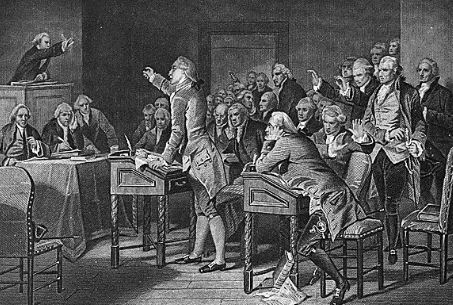 Stamp Act Congress
 - Trial by Jury is a right.
- The use of Admiralty Courts was abusive. (King appointed judge, no jury)
- Without voting rights, Parliament could not represent the colonists.
- There should be no taxation without representation
- Only the colonial assemblies had the right to tax the colonies.
Parliament Answers Back
By 1766, the Stamp Act was repealed, but the Declaratory Act was enacted, stating that Parliament could make laws binding on the American colonies "in all cases whatsoever." During this time, New York, the headquarters for British Troops, refused to assist troops. Scuffles broke out, and Parliament suspended the NY assembly’s power. New York finally paid for the troops, so the suspension wasn’t carried out.
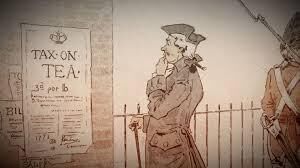 To help pay for governing the colonies, in 1767, Parliament enacted the Townshend Acts, which taxed glass, lead, paint, paper, and tea. Due to these taxes, the colonies tried to discourage the purchase of British goods.
During 1768-1769, colonists began to speak out against Parliament and the taxation of the colonies. Massachusetts called for a unified resistance of the colonies. Virginia wrote a formal letter to the King just before the Royal Governor dissolved its legislature.
In 1770, the Townshend Acts were repealed, except for the Tea Tax. Due to this repeal, colonists began to relax their boycott of English goods. In New York, a riot erupted between citizens and British soldiers because of the NY assembly's noncompliance with the Quartering Act. On March 5, citizens of Boston surrounded British soldiers and were fired upon. Five men died in what is now called the Boston Massacre. 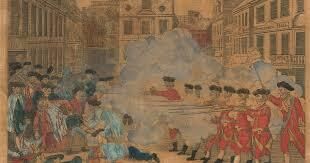 Boston Massacre
Standing Up!
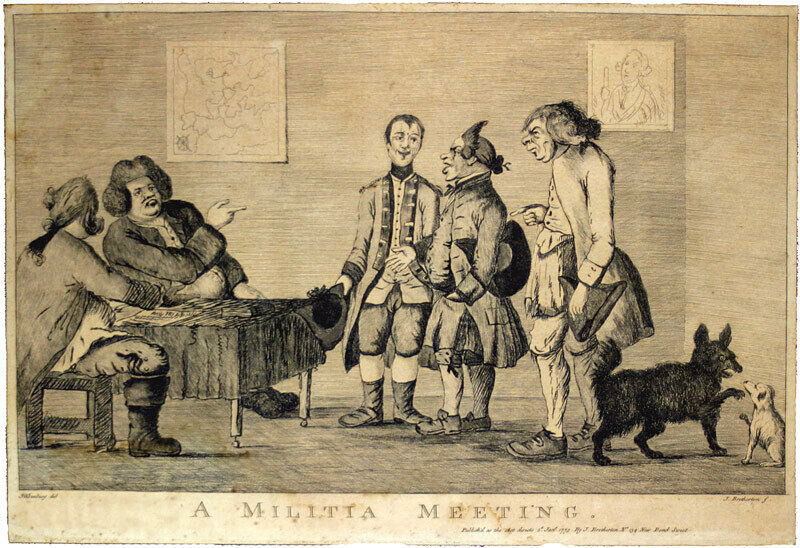 Committees of CorrespondenceIn 1772, Samuel Adams called for Committees of Correspondence to write and inform the other colonies of Boston’s position. They were to outline the colonists’ rights and the infringement of those rights by Parliament. These committees helped to organize the resistance throughout the colonies.
On December 16, 1773, the Boston Tea Party occurred. 342 chests of tea were thrown overboard into Boston Harbor from a ship belonging to the British East India Company. It was a political protest against the Tea Tax that Parliament levied upon the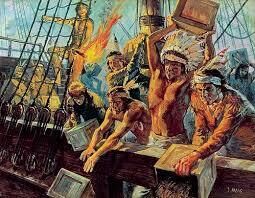 Boston Tea Party colonists and the perceived notion that the East India Company had a monopoly on the tea trade. The Colonists were also angry about not being represented in Parliament, so it was also a protest against “Taxation without Representation.” This was one of the first acts of defiance by the colonists and started them on the road to independence.
After the Boston Tea Party, Parliament responded quickly. In 1774, Parliament passed the Coercive Acts, which are also known as the Intolerable Acts. These consisted of four acts:
- The Boston Port Act, March 25, 1774 – This banned the loading and unloading of any ships in Boston Harbor.
- The Massachusetts Government Act, May 20, 1774 – This act restructured the Massachusetts government by abolishing its charter that was in place since 1691. By doing so, Massachusetts became a Crown Colony, giving all power to an appointed official, the Royal Military Governor, Thomas Gage, who was now under the Crown’s control.
- Administration of Justice Act, May 20, 1774 – This act gave the Governor the right to move a trial to another Colony or Great Britain. This took away the right to a fair trial by your peers, a right guaranteed by the Magna Carta.
- The Quartering Act, June 2, 1774 - This was the only Act to apply to all of the Colonies. Soldiers needed to be billeted close to the areas in which they operated. Soldiers were to be housed in “uninhabited houses, out-houses, barns, or other buildings,” yet they were to be quartered at the colonists’ expense.
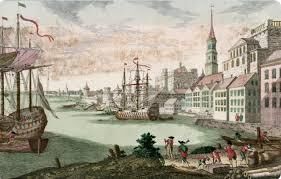 Boston Port Act
Although the Coercive Acts were meant to punish Massachusetts and send a warning to the other colonies, they had the opposite effect. The other colonies came to Massachusetts's defense. This was the first time that all of the colonies were unified. Unlike the previous acts, the Stamp and Townshend Acts, the Coercive Acts weren’t repealed. These policies actually were the spark that ignited the shift in public opinion and led to the Revolutionary War.
Coming Together
In September of 1774, the first Continental Congress, as it has come to be known, was formed to discuss common grievances. The delegates met in Carpenter’s Hall in Philadelphia. The delegates didn’t want to renounce Parliament, and Independence wasn’t even talked about. They discussed the Coercive Acts and found them tyrannical. The Congress adopted the Articles of Association on October 20th and set a deadline for the Coercive Acts to be repealed by December 1, 1774. If they weren’t repealed by September 10, 1775, there would be an embargo of exports to Great Britain. On October 26,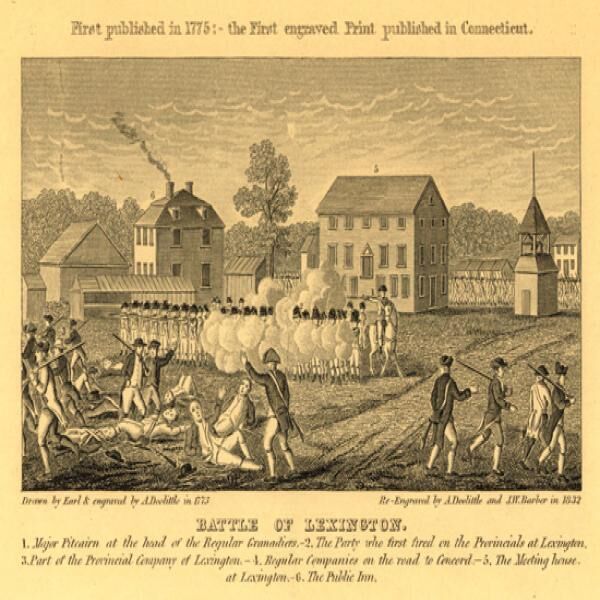 Grievances were drafted in the form of a formal petition to King George III.
In 1775, Parliament passed the Restraining Act. This act allowed New England to trade with England but cut off trade between them and other countries.
On April 19th of 1775, in the towns of Lexington and Concord, American and British troops fired on each other. 700 British soldiers were sent to suppress the rebellious colonists. In the end, 49 colonists were killed, and 39 were wounded. There were 73 British killed and 174 wounded. Those opening shots at the Battles of Lexington and Concord have come to be known as the “Shot Heard Round the World”. Those shots began the War for Independence that lasted 8 yrs.
Independence is Near
The Second Continental Congress convened in May of 1775, electing John Hancock as its president. By then, the war had started. The Olive Branch Petition, drawn up by John Dickinson, which tried to resolve issues between the Colonies and Great Britain, was sent to the King, but he refused to receive it. As the British authority started to collapse, the Continental Congress took over as the government. Anti-independence members of Congress changed their minds after Parliament authorized the seizure of all colonial vessels. In response, Congress opened ports to all foreign powers except Britain. By 1775, although other solutions for a peaceful end were considered, it was becoming increasingly unlikely that one would be found. By April of 1776, Silas Deane had secured France's informal support for the Colonies. Congress also drafted the Model Treaty to seek support from not only France but also from Spain.
In April of 1776, the North Carolina Provincial Congress authorized its Delegates to vote for independence at the Second Continental Congress in Philadelphia. The Halifax Resolves, listing grievances against Great Britain and calling for independence, were agreed upon by all 83 members and stated the Congress’s intentions for independence, which were part of the meeting's minutes. 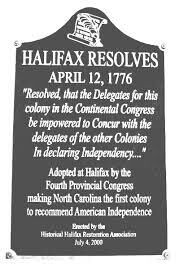
On May 15, the House of Burgesses in Virginia also voted on a resolution concerning independence. On June 7, 1776, under the instructions of the Virginia Convention, Richard Henry Lee of Virginia introduced a resolution to the Continental Congress in 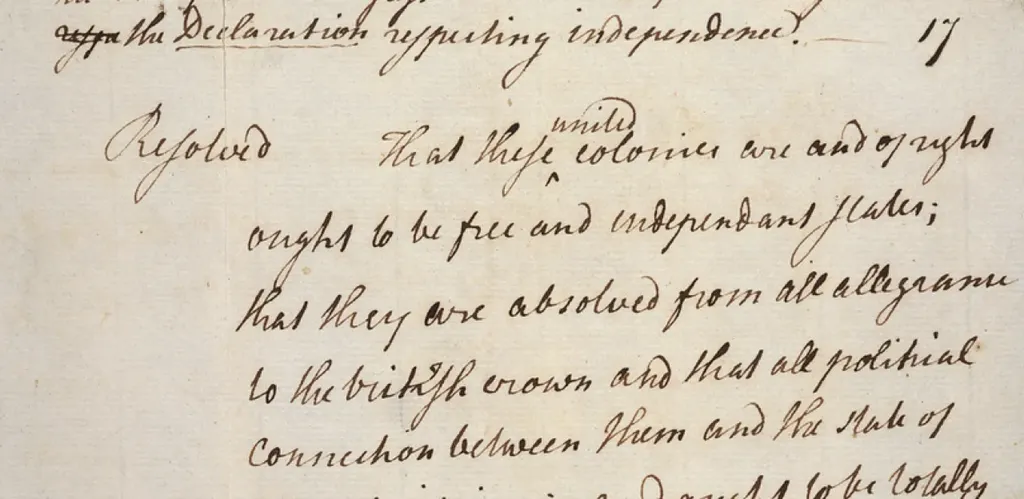 Lee ResolutionPhiladelphia, which stated that the Colonies should be free and independent states. Where the Lee Resolution states that the colonies “are and of right ought to be free and independent states”, the Halifax Resolves listed the grievances against the king.
On June 11th, three committees were set up to work on the resolution. Those committees were tasked with:
- Forming foreign alliances
- Preparing and digesting the form of a confederation
- Drafting a document or Declaration – A petition to the King of England
The Declaration is Born!
Jefferson was chosen by the committee, which included a New York representative named Robert R. Livingston, to draw up the document, with John Adams chosen second. Adams decided that Jefferson should pen the document, and he gave him three reasons why:
- Jefferson was from Virginia, and Adams felt someone from Virginia should be the writer.
- The second reason he gave was that Jefferson was popular and liked by the other delegates, whereas Adams felt he was not.
- Finally, Adams conceded that Jefferson was a better writer than he.
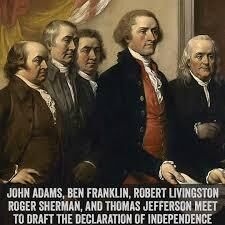 The Men on the Petition Committee
Jefferson took up residence on the third floor of a home owned by a Mr. Graff. He then penned the Declaration of Independence on his writing tablet. A rough draft was submitted to the committee on June 28th. Before doing so, Adams and Franklin were given the document, and their suggestions were incorporated. Livingston, a Columbia-educated lawyer, contributed his legal expertise and regional perspective to the document. In total, more than 80 drafts of the Declaration were made.
The adoption of the Resolution of Independence took place on July 2, 1776. New York abstained from the voting. Their Provincial Legislature had not approved the vote for independence. The delegates would have to wait until they were authorized to do so. With the Declaration becoming the order of business on July 3, Congress began making changes to the document, including deleting the passage on the slave trade. On July 4th, the Declaration was endorsed and signed. The President of the Congress, John Hancock, and Secretary Charles Thompson signed the Declaration.
Once the Declaration was signed, Charles Dunlap printed copies. The copy was attached to the Rough Journal of Congress, becoming the first official copy.
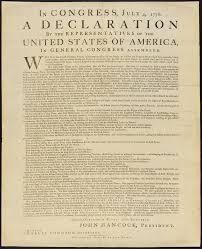 Dunlap BroadsideSince New York abstained for 9 days, the Declaration could not be called the “Unanimous Declaration by the Representatives of the United States General Congress.” Instead, it was titled “A Declaration by the Representatives of the United States General Congress.” On July 9th, the New York Provincial Congress met in White Plains and endorsed independence.
New York was in a unique position during this time. Although they understood that the colonies were moving towards independence, they were also economically tied to Great Britain. Like most colonies, they were politically divided and faced the possibility of British retaliation. The British were already preparing to target New York. Independence from Great Britain wasn’t an easy decision.
After receiving New York’s vote, the Declaration was printed on parchment by Timothy Matlack of Philadelphia. This printing of the Declaration was signed on August 2. Some of the men who had voted in July were not available to sign the document in August. Others, who were not in attendance in July, did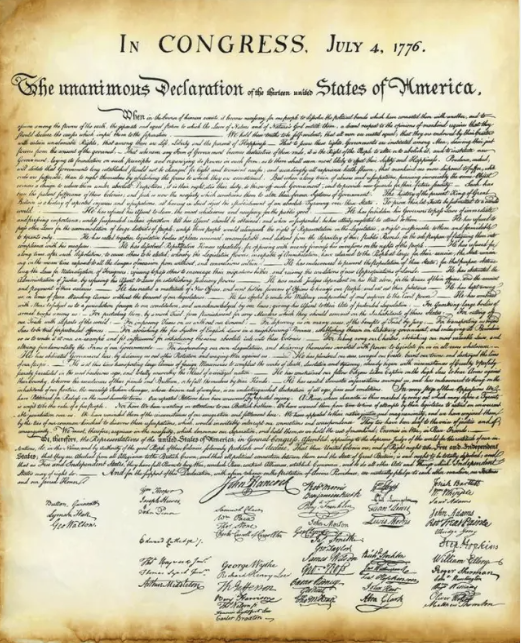 Declaration of Independence sign their names. An authenticated copy of the Declaration, bearing the signatures of those who voted for independence, was sent to each state in January of 1777. John Hancock’s and Charles Thompson’s signatures were the only actual ones on the copy. The rest were printed. The only name not on the Declaration was Thomas McKean. He did not have a chance to sign it until later. Livingston had missed the official signing of the document in August of 1776. He was called back to New York on urgent business.
Next month will be the last article in the New York Revolution series. You will find out what New York's reaction was upon hearing the Declaration read for the first time.
Resources
Illustrations
Fort Necessity, French Indian War https://share.google/j2wOMWOWL2ysDstMu
Marching against Taxes https://share.google/zQHBI4xvh0OUmEMd5
Stamp Act Congress https://share.google/SmVs0TImg8kxhcUi0
Townsend Acts Tea Tax https://share.google/BDZiDTGom5YbXkTtl
Boston Tea Party https://share.google/D3usmTKDTMPOk8fBl
Boston Port Act https://share.google/s3Lj8J7XGclm83G35
Quartering Act https://share.google/WfzIkQYiexFG4rN2p
Boston Massacre https://share.google/sDPPmZrGHYB0XszCg
Committees of Correspondence https://share.google/EWfcx4K9yfWGuf5fA
Second Continental Congress https://share.google/RifScymKXwHIW3CLg
Halifax Resolves https://share.google/mrLJDVlicAJoaea26
Lee Resolution https://share.google/yjRnTsxUcHr7PUyJz
Declaration Committee https://share.google/Cl0kQiHmkjc5NH4Y2
Dunlap Broadside https://share.google/aW15PTcHzIJRMKHTi
Declaration of Independence https://share.google/439IAsMQXZ37vaa5R
The Class of 1976 is gathering information to see if anyone is interested in a reunion to celebrate 50 years since graduation. A Facebook page has been created: Hicksville Class of 1976. Join that page to see the latest news!
Etcetera for May 2026
In Memoriam
April Lang Maser, Class of 1983
Steven Johnson, Class of 1979
Thank you to Ann Arroyo for sending us these updates.
Class of 1964
Michael Germaine, Yvonne Kerner, Richard Medina
Class of 1965
Grayce Elton, Raymond Gallagher
Joint Reunion
Ann Arroyo sent us photos from the joint reunion. They are on the website under Photos>Reunions>60-Year. Click here.