
Whalers
The Island long had been home to whaling fleets. Oyster Bay, Cold Spring Harbor, Sag Harbor (shown above in the frontispiece of this article) and Greenport all had facilities with refitters who were familiar with whalers, and who converted a number of them into slave ships during the 1840s and 1850s.
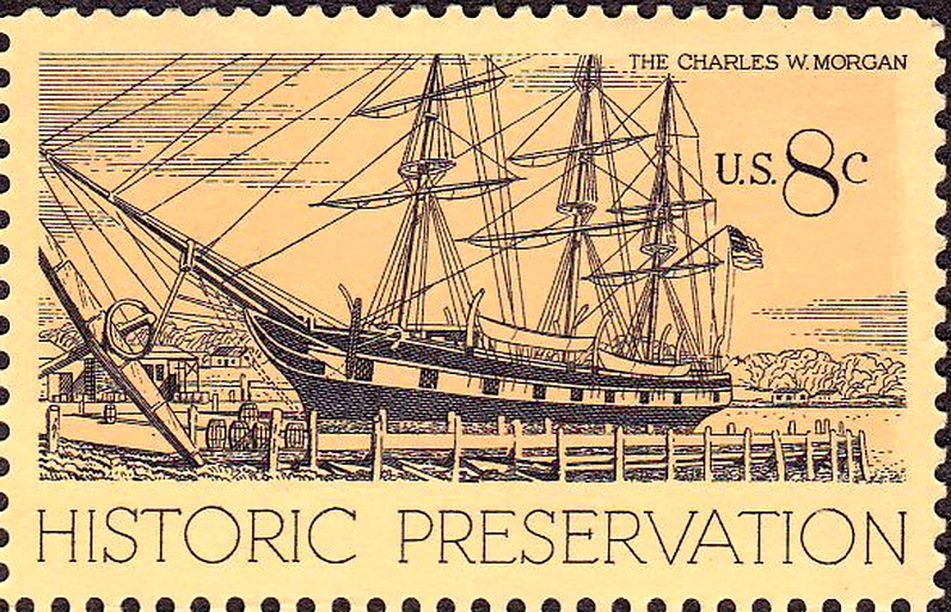 What northeast American whaling ships looked like
Postage stamp of “Charles W. Morgan”
built in New Bedford, Massachusetts, 1841
Old whaling ships were abundant, reasonably priced, and easier to turn into slavers than were many cargo vessels. Built for extremely long voyages, they already were equipped to carry large supplies of fresh water and food. Their cavernous holds could be modified to transport slaves instead of barrels of whale oil. Their decks had “try works” for boiling down whale blubber into oil; these could be turned into primitive kitchens for feeding hundreds of people. Although not swift enough to evade steamship patrols, they might not have to: whales in the ocean near Africa’s slave coast attracted many whaling ships, and a converted whaler might simply blend in.
At least two Sag Harbor whalers were repurposed in the 1840s and 1850s. One was refitted locally; the other was reworked more extensively in Greenport, to substantially increase its slave capacity. Local harbor masters, either corrupt or apathetic, ignored the illegal modifications. In the case of the Greenport conversion, however, someone alerted the Federal Marshall. Before the ship could sail, both its Captain and owner were arrested. The latter escaped from jail and disappeared; he resurfaced as a celebrated Confederate blockade runner during the Civil War.
It may have been easier to convert a whaler into a slaver and send it on its way on Long Island than in New England. The “Romulus” mentioned at the start of this article was originally a Rhode Island whaler, but she was laying in supplies at Cold Spring Harbor. Similarly, the whaler “Brutus” was being converted to a slave ship in its home port of New Bedford, but the work was stopped when the harbor master became suspicious. It left New Bedford, officially on a whaling voyage, but slipped into Cold Spring Harbor to complete the refitting. Evidently, word of the “cooperative” harbor master there had spread. He failed to perform his duty by not recording its arrival or later departure, but he did make a note in his personal diary (discovered many decades later) about the refitting of the “Brutus.”