
 You will notice Member Comments are back, thanks to our Webmaster, Bruce Scherzinger! We would love to add some writers to our team! We are looking for a successor Webmaster with CMS experience to ensure that HixNews is around for generations to come. Please email us at
View The Hix News Team
Thomas Connolly - '74, Financial Conversations
Joseph Platt - '64
John Maniec - '64
Webmasters:
Web Development and IT:
Editors Emeritus:
David J. Rubin - '82
Elliot Gorlin - '63
Valerie Pakaluk - '51
Henry Lichtenstein - '59
Marc Malamud - '77
Founding Editors:
Pat (Koziuk) Driscoll - '56
Linda (Piccerelli) Hayden - '60
Buffalo Bob Casale - '61
Founding Webmaster:
Roger Whitaker
 Introduction
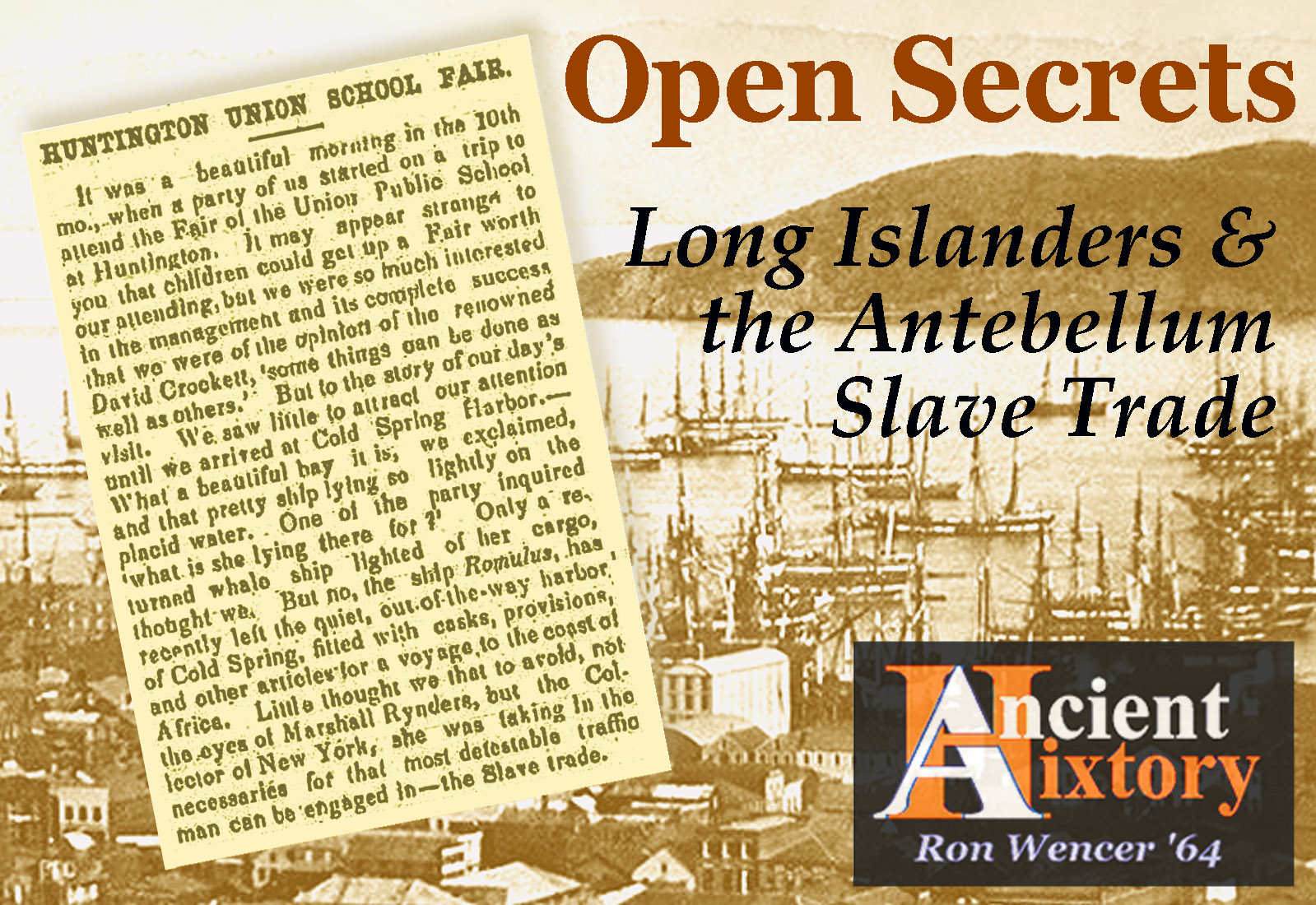
In January 1861, as winter set in, a writer at the Huntington Long-Islander newspaper looked back a few months, to an autumn day when a few friends strolled to a school fair. At Cold Spring Harbor, they were struck by the beauty of the bay, and by a “pretty” sailing ship that lay at anchor. Then the tableau was spoiled; they learned that the old whaler was taking on supplies for the slave trade.
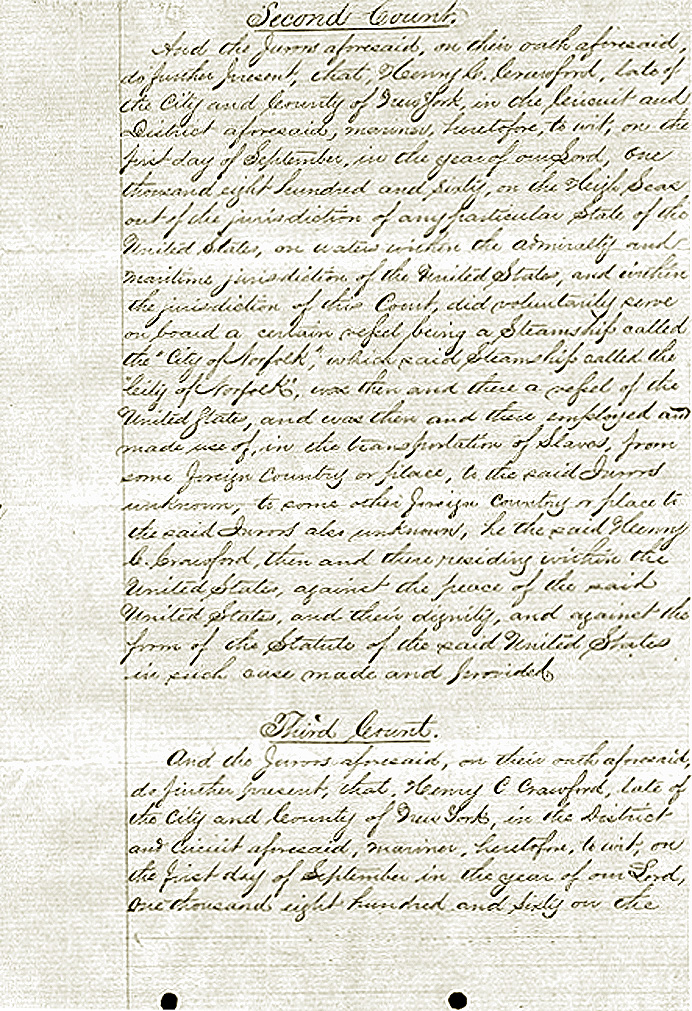 They probably didn’t know that several miles down the road in Hicksville, troubling news was brewing about another ship, the freighter “City of Norfolk.” Some months earlier, it had recruited seamen in Lower Manhattan for a cargo run to Europe, but well into its voyage, the Captain (Henry C. Crawford, reportedly a resident of Hicksville) revealed to them that the ship was a slaver, bound for Africa. The sailors had been coerced into seeing the voyage through, but now they were back in New York, and preparing to testify in Federal court against him. The newspapers would report that Crawford had made “fabulous sums in slave traffic.”
Although slavery itself was still legal in some parts of the nation, trafficking new slaves anywhere in the world was considered piracy by the United States, and it could earn an American a death sentence. Rather than risk a trial, Henry Crawford would plead guilty. Part of his indictment is shown here.
 Rejecting the Slave Trade (or Not)
Slavery had been part of Long Island from the earliest years of European settlement. The Dutch held slave auctions in Nieuw Amsterdam; some of the early Quaker settlers in Jericho kept slaves. After 1800, however, most Europeans and Americans thought the African slave trade inhumane and repugnant, and pressed their respective governments to end it. But even in the North, there were those who favored the continuation of slavery throughout the nation. In 1846, the very patriotic Long Island Farmer printed an article that asked its readers to imagine how their ancestors would have reacted to abolition: “I have no right to my negroes that I bought with my own money? We’ll see about that!” It went on to say that, unlike contemporary freed northern slaves, the old slaves “were no fools, and so stuck to their old masters, whom they had taken for better or for worse….” Evidently, the author had difficulty distinguishing between wives and slaves.
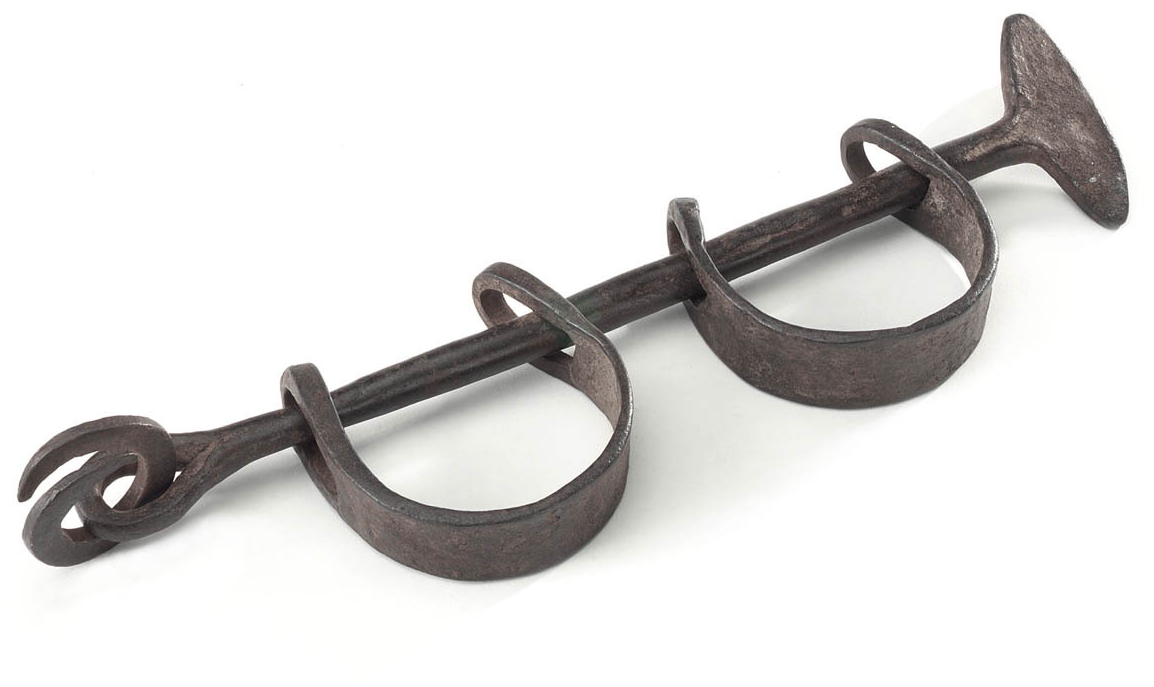
Others involved in the slave trade were less philosophical; they simply chose to profit from it. Harbor masters and sheriff’s deputies accepted bribes to ignore illegal activities. Sailors sailed on slave ships. Shipyards rebuilt whaling ships or freighters into slavers. Blacksmiths made things like leg irons to keep slaves in place on ships.
Whalers
The Island long had been home to whaling fleets. Oyster Bay, Cold Spring Harbor, Sag Harbor (shown above in the frontispiece of this article) and Greenport all had facilities with refitters who were familiar with whalers, and who converted a number of them into slave ships during the 1840s and 1850s.
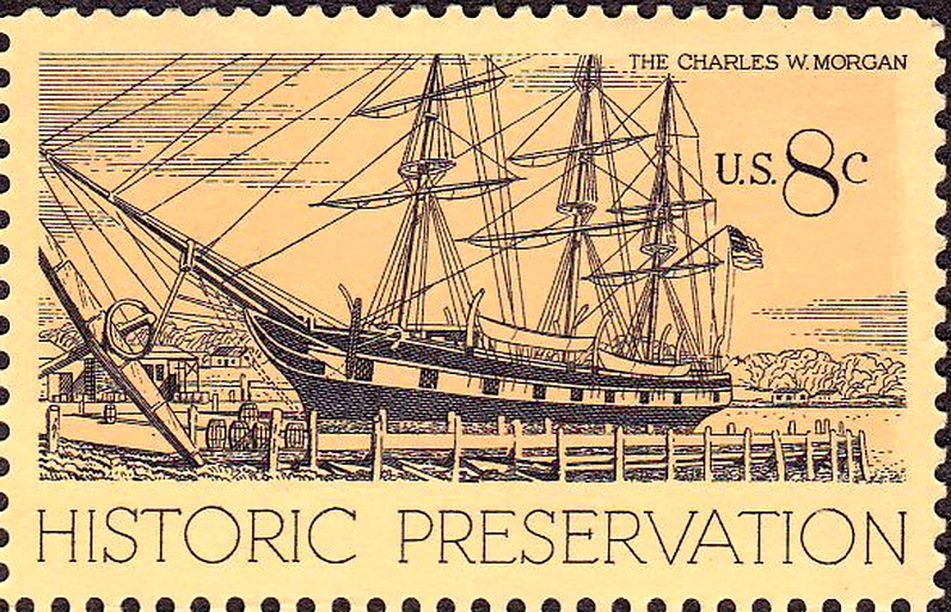 What northeast American whaling ships looked like
Postage stamp of “Charles W. Morgan”
built in New Bedford, Massachusetts, 1841
Old whaling ships were abundant, reasonably priced, and easier to turn into slavers than were many cargo vessels. Built for extremely long voyages, they already were equipped to carry large supplies of fresh water and food. Their cavernous holds could be modified to transport slaves instead of barrels of whale oil. Their decks had “try works” for boiling down whale blubber into oil; these could be turned into primitive kitchens for feeding hundreds of people. Although not swift enough to evade steamship patrols, they might not have to: whales in the ocean near Africa’s slave coast attracted many whaling ships, and a converted whaler might simply blend in.
At least two Sag Harbor whalers were repurposed in the 1840s and 1850s. One was refitted locally; the other was reworked more extensively in Greenport, to substantially increase its slave capacity. Local harbor masters, either corrupt or apathetic, ignored the illegal modifications. In the case of the Greenport conversion, however, someone alerted the Federal Marshall. Before the ship could sail, both its Captain and owner were arrested. The latter escaped from jail and disappeared; he resurfaced as a celebrated Confederate blockade runner during the Civil War.
It may have been easier to convert a whaler into a slaver and send it on its way on Long Island than in New England. The “Romulus” mentioned at the start of this article was originally a Rhode Island whaler, but she was laying in supplies at Cold Spring Harbor. Similarly, the whaler “Brutus” was being converted to a slave ship in its home port of New Bedford, but the work was stopped when the harbor master became suspicious. It left New Bedford, officially on a whaling voyage, but slipped into Cold Spring Harbor to complete the refitting. Evidently, word of the “cooperative” harbor master there had spread. He failed to perform his duty by not recording its arrival or later departure, but he did make a note in his personal diary (discovered many decades later) about the refitting of the “Brutus.”
Better-Organized Crime
By 1850, ocean patrols and harbor surveillance had effectively stopped the smuggling of slaves into French and British territories in the Caribbean as well as the American South. Cuba and Brazil remained vulnerable; their plantations were desperate to pay for new slaves, whatever the price. The risks and profits of slave trading skyrocketed. Independent ship owners and captains gave way to international cartels with deep pockets; lawyers and accountants gained power. With a cartel’s legal responsibilities and financial exposure limited, it could operate multiple voyages a year, hypothetically lose half its ships, crews, and human “cargo“ to storm or seizure, and still make incredible profits.
Disguised as a freighter or a whaler, a ship would set sail from a northeast American port for some announced destination. Several days out, it would change course, and head for the Danish West Indies, to stock its hold with slave trading supplies. It then would sail to the African coast, where innocent villagers captured specifically for this ship’s voyage were already imprisoned in slave pens. Then came the long, terrible voyage west. Despite the slaves being valuable “cargo,” they were treated as expendable sub-humans. Many succumbed to disease, malnutrition, beatings, or the excessive heat in the ship’s hold. Some starved themselves in despair; some tried to rebel and were slain. Sick and dead slaves alike might be chained together and tossed overboard, tied to weights so that their bodies would not float to the surface and betray the presence of a slave ship in the area.
After the survivors were delivered, the ship would be burned to the waterline and sunk in deep water, in hopes of destroying all evidence of the voyage. Crewmen and officers would find other ships on which to work their way home.
Brokers, Secrecy
Voyages were organized by brokers, usually based in northern Atlantic U.S. ports. They communicated in code with specialist cartel agents to acquire ships, refit them, handle international cash flow, find trustworthy Captains and First Mates, etc. Brokers fixed ad hoc problems in port, bribing harbor masters, explaining away modifications to a ship that suggested it was a slaver. Experience taught brokers which officials had to be circumvented by postponing some refitting and resupplying until after a ship left port. When this happened for a Manhattan departure, a cozy Long Island harbor was the obvious next stop.
Captain Crawford’s Voyage
The “City of Norfolk” was one three voyages brokered in 1860 by Albert Horn on behalf of the Portuguese Mora Cartel (named after its two bosses, brothers who respectively operated in Europe and the U.S.). It had agents in Africa, Europe, the Caribbean, Brazil, Cuba, and American cities. They communicated via coded messages, embedded in postal mail that crossed the oceans on ship, telegrams that crossed nations by wire, and written messages concealed in wealthy travelers’ luggage, garments, and personal items. To combat the cartel, American and British agents broke codes, steamed open and re-sealed intercepted letters, created disinformation, and even inserted double agents into the cartel.
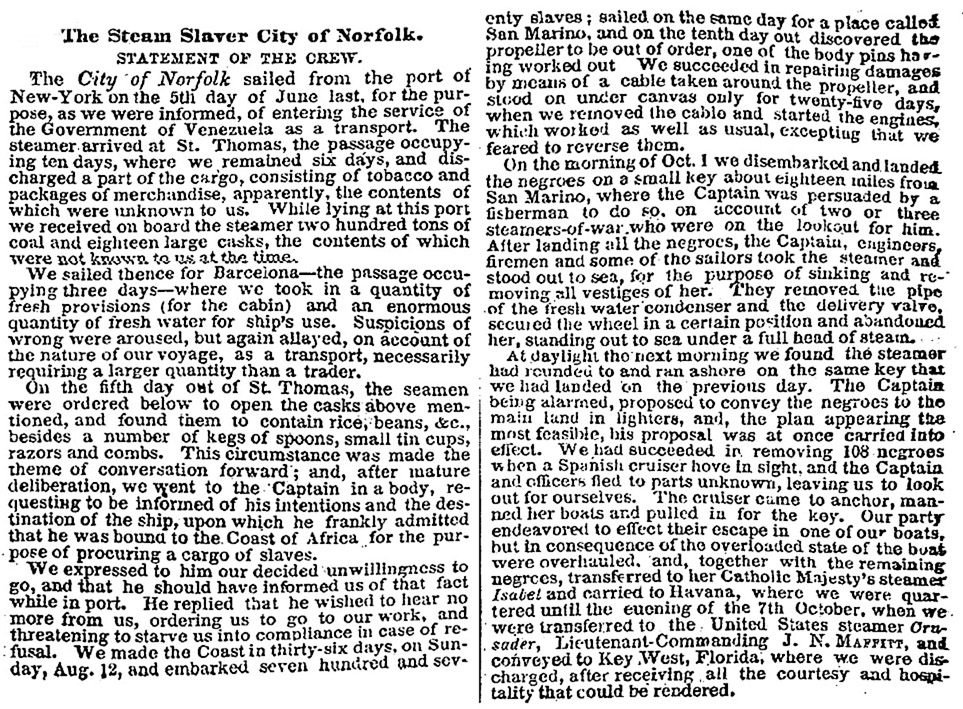
As the “City of Norfolk” neared its final delivery spot in Cuba, Spanish patrols were on watch, and it could not outrun them. The Spanish took everyone to Havana to sort things out. The Africans who remained on board were not sold into slavery. The ship’s officers and crew were taken to Key West. Those crewmen who had been hoodwinked into serving on a slaver drafted a statement that would help substantiate the later indictments against Horn and Crawford. It was printed in the New York Times of October 26, 1860:
Wrap-Up
I have been thwarted in my efforts to learn more about Henry C. Crawford, but I am not surprised. He could not have been born in Hicksville, because to serve as a First Mate or Captain in 1860, he must have been born before people of European ancestry permanently lived there. As an adult, he likely was at sea most of the time, and thus missed being recorded in censuses and local directories. If he did live in Hicksville, he may have kept a room in the Grand Central Hotel, and used it only between voyages. I have not yet found any record of where he was incarcerated.
Albert Horn was pardoned a few years later by Abraham Lincoln, because he was dying from acute lung disease. Given the thousands of people whose lifetime slavery he arranged, I question Lincoln’s showing him mercy.
As a child, when I learned about the Civil War, I felt irrationally smug about being a Northerner. The North was “where the good guys came from.” I clung to that thought for a long time, but I eventually realized that life is more complicated than it seemed in my childhood. Having now looked into the grim world in which Henry Crawford and men like him lived, I am less sure about things, but I can say this: The North was not all good guys.
Sources
- John Harris, The Last Slave Ships: New York and the End of the Middle Passage
- Letter from Albert Horn Refuting Allegations of Slave Trading, New York Tribune, June 1, 1860
- The Steam Slaver City of Norfolk, New York Times, October 25, 1860
- Important Arrest of Alleged Slave Traders, Brooklyn Eagle, May 3, 1861
- Huntington School Fair, Huntington Long-Islander, January 11, 1861
- Various criminal records related to Albert Horn and/or Henry Crawford, National Archives and Records Administration, online at catalogarchives.gov
- Voyage of The City of Norfolk, slavevoyages.org
- Ouidah in the slave trade, Wikipedia
- Illustration of Leg Irons, understandingslavery.com
- U.S. Postage Stamp that depicts Whaling Boat, Wikimedia Commons
- Photograph of Sag Harbor in the 19th century,
- https://hamptonsboatrental.com/hamptons-things-to-do-blog/sag-harbor-highlights
- Kevin S. Reilly, Slavers in Disguise: American Whaling and the African Slave trade, 1845-1862, The American Neptune, Peabody Museum
- The Whaling Ship That Sank as a Slaver, timqueeney.com
Finis!
New York - The American Revolution Part 3
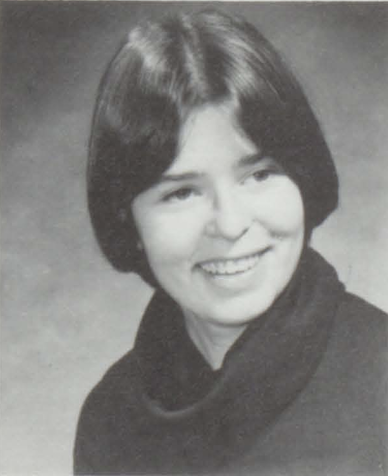 Wendy Elkis Class of 1977
In 1775, Parliament passed the Restraining Act. This Act allowed New England to trade with England but cut off trade between them and other countries. This act made New England dependent upon British goods. An addition to this Act was forbidding colonists from fishing in the Atlantic. None of this sat well with the colonists. The rising tensions from the Restraining Act led to the Battle of Lexington and Concord.
In April 1775, News of Lexington & Concord spread throughout the colonies. Once news of Lexington and Concord reached New York, it sparked action among patriots. NY's Sons of Liberty overthrew the colonial government, forcing the Governor to flee to a ship in the harbor and the Lieutenant Governor to flee to Long Island.
Thomas Gage and Lexington and Concord
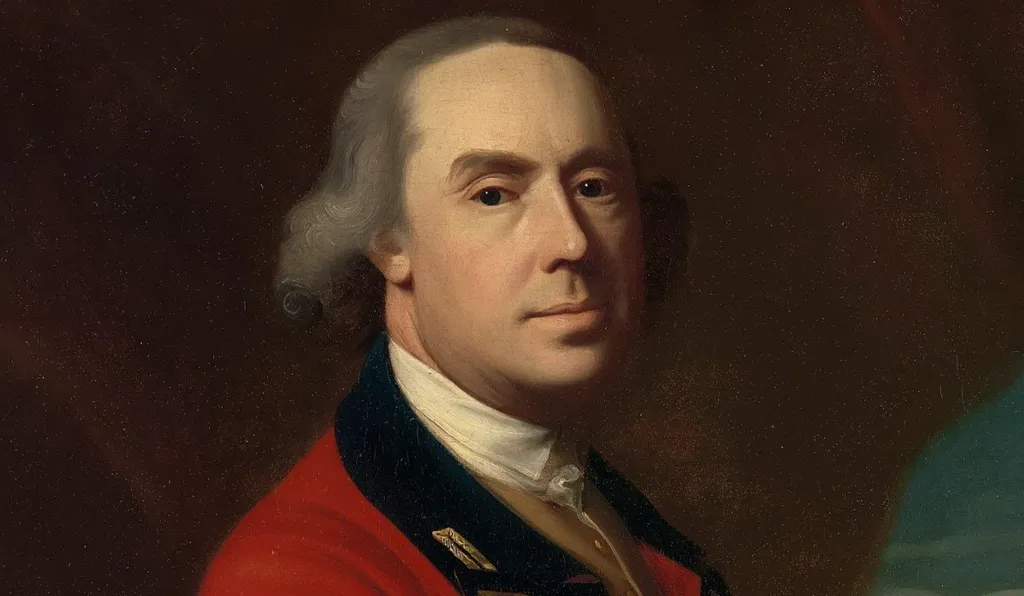 Thomas Gage General Great Britain Thomas Gage became the Commander-in-Chief of North America, a temporary position, in 1763. Gage was responsible for the increase of British troops in New York and Boston. This eventually led to the Boston Massacre, although at the time of the massacre, Gage was back in England. When he returned to North America in 1774, he was made the Governor of Massachusetts. In April of 1775, Gage was given the order to attack the town of Concord and not only retrieve the stockpile of armaments there, but also to take Samuel Adams and John Hancock into custody. Fortunately, they were forewarned and were able to escape.
On April 19th of 1775, in the towns of Lexington and Concord, American and British troops fired on each other. 700 British soldiers were sent to suppress the rebellious colonists. That was the night that Paul Revere made his famous ride. In the end, 49 colonists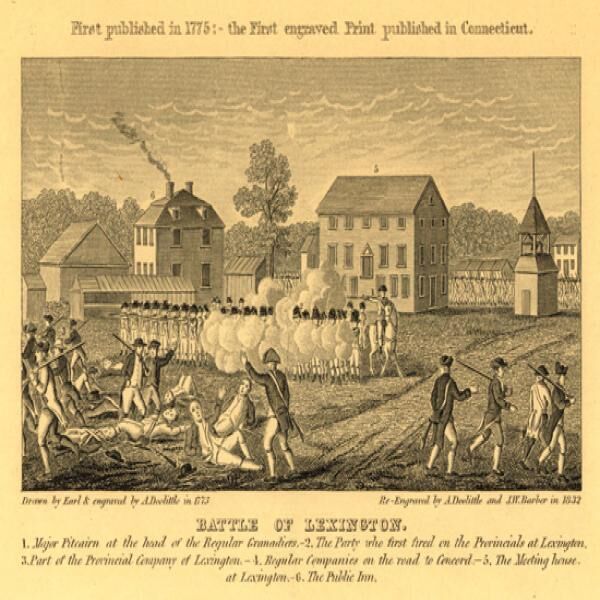 Lexington and Concord were killed and 39 wounded. There were 73 British killed and 174 wounded. Those opening shots at the battles of Lexington and Concord have come to be known as the “Shot Heard 'Round the World”. Those shots began the war for independence that lasted 8 years. Ready to join in the uprising, the Sons of Liberty in New York overthrew New York’s Colonial Government.
New York's Governor
Governor Tryon was made the Royal Governor of New York in 1771. Tryon came from North Carolina, where he used harsh methods to quash the 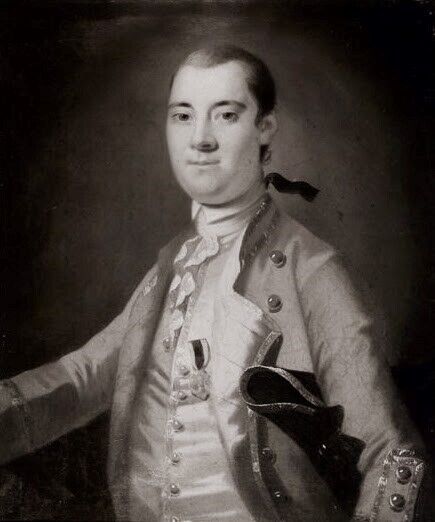 Gov. William TryonRegulator movement, a group of men looking for redress of their grievances. When those grievances went unresolved, they began withholding taxes, reclaiming confiscated property, and disrupting the courts. Tryon called upon the militia to suppress them. This led to the Battle of Alamance, May 16, 1771. Tryon was moved to New York shortly after that battle.
After being moved to New York, Tryon was facing the same issues. He was facing a growing anger amongst the colonists, especially the Sons of Liberty. The Sons of Liberty was a Patriot group that, by 1775, moved from protest to armed defiance. They intimidated Loyalists, seized British arms, and stopped the importation of British goods. They also provided logistical support for the Continental Army. Due to this environment, Tryon returned to England in 1774 to retreat from the anger of the Sons of Liberty. He returned to New York in October of 1775, where he was forced out of New York and sought protection aboard a British ship.
The Lieutenant Governor Cadwallader Colden of New York had his home in Orange County, near Newburgh. He was born in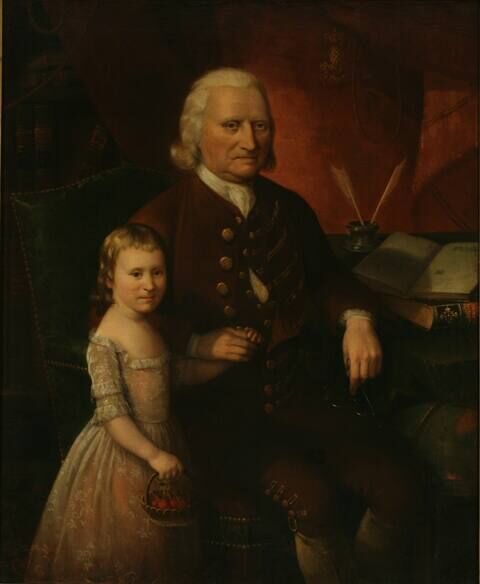 Cadwallader Colden Scottland in 1688 and immigrated to the Colonies at 29. He studied medicine and was friends with Benjamin Franklin. He was adopted by the Mohawk nation and admired the ways of the indigenous people. He became New York’s Lieutenant Governor and sided with the crown. Once news of Lexington and Concord reached New York, and with the rising of the Sons of Liberty, Cadwallader Colden retreated to Long Island. Rioters in New York burned him in effigy, and his prized coach was set on fire. He passed away that same year at the age of 88.
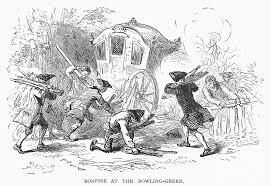 Cadwallader Colden's Carriage Attacked
Check out our April Newsletter for Part 4 - 1775-1776: New York City, a vital port, saw its population dwindle as Loyalists fled, fearing Patriot rule and the looming conflict.
Resources
The Restraining Act
https://www.history.com/this-day-in-history/march-30/king-george-endorses-new-england-restraining-act
Lexington and Concord
https://historynet.com/lexington-and-concord-the-night-a-nation-was-born/
https://www.battlefields.org/learn/primary-sources/describing-events-took-place-lexington-and-concord
https://wams.nyhistory.org/colonies-and-revolution/the-american-revolution/fear-and-danger-in-ny/
William Tryon
https://www.battlefields.org/learn/articles/governor-william-tryon#:
Cadwallader Colden
https://hvmag.com/life-style/cadwallader-colden/
https://www.battlefields.org/learn/biographies/thomas-gage
https://www.battlefields.org/learn/battles/alamance
Sons of Liberty
https://www.battlefields.org/learn/primary-sources/association-sons-liberty-new-york
https://www.newyorkalmanack.com/2025/08/1775-new-york-city-british-arms/#:
Illustrations:
Carriage: https://share.google/BNIinE20Ux9GEjudn
Sons of Liberty Paper: https://www.battlefields.org/learn/primary-sources/association-sons-liberty-new-york
Thomas Gage: https://www.americanhistorycentral.com/entries/thomas-gage/
William Tryon: https://www.nps.gov/people/william-tryon.htm
Cadwallader Colden: https://oll.libertyfund.org/people/cadwallader-colden
Lexington and Concord: https://share.google/gt5jrIVvWkObuk7BO
Sons of Liberty: https://tinyurl.com/mr3snrr4
By October 1918, the number of American war casualties was growing rapidly. At home, a Liberty Loan fund-raising campaign - the fourth in 19 months - was attracting crowds to its rallies, urging them to lend the government more money with which to fight the war.
Meanwhile, the novel influenza virus which first struck the country in January had returned, more lethal and widespread than before. Coffins were back-ordered all over America , and cemeteries were running out of empty graves. For every American soldier or nurse who lay dying in Europe, three or four civilian Americans lay dying back home. President Woodrow Wilson said nothing about it.
A Fictitious 'Normal'
Life was supposed to feel normal, but it wasn't - not in Hicksville , not anywhere. It was as if the world was beset by an unending earthquake, one that suddenly toppled people, not buildings. One after another, schools were shuttered as towns tried to protect their most precious resource: their children.
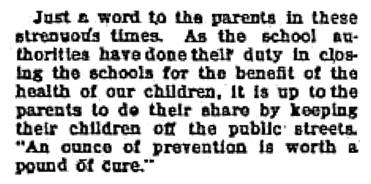
This excerpt, and the one in used in the header,
are taken from the Hicksville section of the
Huntington Long-Islander for October 25, 1918
No one took the trouble to coin the phrase "social distancing," but clearly, people understood the idea well enough where their children were concerned. If you kept your family's children at home, isolating them from others who might be sick, they just might survive.
Adults were another matter. Everyone had to work, especially when there was a war on. And people needed to kick back and socialize now and then; everybody knew that. When parents came home, they would kiss and hug their families. Their children would look to see if their fathers had brought them candy or little gifts. Children's eyes were too innocent to notice any tiny viruses.
Paradoxically, parents who kept their children home from school would take them to the many festive government-sponsored rallies created to support the war effort. The rallies were like little county fairs: parades, military bands, exhibits of machines (in this case, weapons). Parents were excused from work. Children shared the excitement with the friends from whom they normally were isolated, running to line up together, sharing cups of lemonade. In dreary wartime, the rallies seemed like gifts from the government.

James Bourgholtzer, Victory Loan ceremony, c.1918
U.S. National Archives, Public Domain Archive
This is NOT Hicksville, but comparable displays were set up in
Long Island towns. People flocked together when they saw them;
boys especially were eager to touch artillery pieces or tanks.
No one had been told that the nation's top medical experts had urged the Wilson administration not to stage parades or rallies like these, for fear that such events would magnify the spread of the lethal epidemic. Indeed, during the entire epidemic, the President would make no public mention of it.
The government wanted life to be as normal as possible. It even went so far as to urge the mourning mothers of dead servicemen to wear white, not black, so that they would not stand out so much in public. Woodrow Wilson had visited England , and noticed mothers in black all over; he had found them depressing.
It was not only Mr. Wilson who was silent, for there was an ample supply of like-minded men willing to serve in his administration. News about the war and the epidemic was controlled - sometimes censored outright - by the Committee on Public Information (think of Orwell's book 1984), which was concerned less with Americans' well-being, and more with the impact of public morale on the war. The Committee's head, Arthur Bullard, once famously said:
"The force of an idea lies in its inspirational value. It matters very little if it is true or false."
The administration did its best to censor news reports that might reveal the epidemic's breadth and depth, for fear that public resolve to win the war might be weakened. Although theoretically in the dark, the people were not as stupid, or as blind, as the government seemed to think. Schools were closed nearly everywhere. Newspapers carried more obituaries than before, sometimes more pages of obituaries. Many funeral directors had to store filled coffins outside their establishments. In Queens, St. John Cemetery was using a steam shovel to dig temporary mass graves for them; another cemetery was storing them in its utility sheds.
The Hicksville section in the Huntington Long-Islander added an "Our Sick" column, in effect warning its readers about who in the village might pass away before next week's edition of the paper arrived. Despite the gravity of content, today's cynical reader may smile when reading through the obituaries. Whether for fear of censorship, or simply because the Long-Islander's writers worried about repeating the same dreaded word too often, not very many deaths were ascribed to "flu" or "influenza." Instead, many people were suddenly dying of "the grip" (a 19th century word for influenza), or of pneumonia (the most common consequence of this influenza; in Nassau County, 25% of the influenza victims who developed pneumonia died of it).
Normal? Life in 1917 had been normal. Life in 1918 was terrifying.
Not Factual But Persuasive Enough
Joseph Pennell, Poster for the Fourth Liberty Loan Campaign, 1918
Wikimedia Commons
Wrecked ships are strewn in New York harbor, enemy bombers attack,
and the Statue of Liberty peers through the smoke at the burning city.
Once again, it mattered very little if it was true or false. The government was not above using the terror of the times to raise money for the war, as seen in the poster above. The image was pure propaganda, not prophecy. It was an impossible nightmare, concocted to scare people into again buying Liberty Bonds.
In 1918, and for years to come, massive air assaults would not be possible. There were too few bombers, which could not fly far enough, and could not carry many bombs. The bombs they could carry were too small to inflict widespread damage. What's more, there was no way for the short-range bombers of the day to leap-frog across the Atlantic.
A poster like this was the stick; the candy was a traveling display of "war trophies."
The General Pershing War Trophy Train
Lentz, Poster (Hey Skinnay! The War Trophy Train), c.1918
digital.librarycompany.org
Soldiers from Hicksville (and in general, from anywhere in the country) had first arrived in France early in September of 1917. By that time, after three years of European combat, prisoners has been captured and exchanged, the front had moved back and forth multiple times, and many men had died on "the wrong side" of it. Much equipment and weaponry had been captured or simply abandoned in place. Discards were everywhere: helmets, uniforms, defunct artillery pieces, indeterminate objects bearing insignia. It all became fodder to use for fund-raising.
By the time of the Fourth Liberty Loan campaign, the U.S. had collected and organized surplus matériel de guerre into trainloads of "trophies" that would crisscross America. The trains' arrivals were carefully staged. Nearby workplaces were told in advance to close, so that workers and their families would be ready. The locomotives' shrill whistles would blow steadily as they neared towns; factory whistles would join in. Military aircraft sometimes flew overhead and dropped "blank" bombs, which exploded above. Bands played as parades led the community to the Trophy Train.
The stops typically lasted for two hours. The trains brought dignitaries to address the crowds, and a combat veteran or two (perhaps Canadian or British). Local clergy and politicos added their own thoughts. All of them urged the audiences to buy more bonds or to donate - incidentally, each town had been assessed a target dollar amount; it would not do for one's town to miss the quota. Most of the locals (at least most of the males) toured the exhibits. Small souvenirs of the war might be sold to raise additional funds.
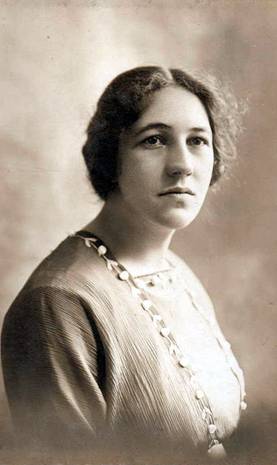
Shirley Wajda, America's World War I Trophy Trains: War Relics as Propaganda
medium.com/@shirleywajda/americas-world-war-i-trophy-trains-war-relics-as-propaganda-57f7a9b811e1ts
Much to Hicksville's dismay, the "Pershing Train" was behind schedule when it rolled into town, and thus its stop was briefer than planned. All town businesses had been closed for the afternoon. While waiting for the delayed train, a band from one of the local military airfields played for the crowd, and it also accompanied the singing of two soloists who were stationed at the field. The last two Civil War veterans residing in Hicksville presented the village with a large new flag, which was hoisted on the pole at Depot Square. More than $40,000 worth of bonds was sold.
The Eagle offered a detailed account of the train's stop in Freeport, which lasted longer:

Brooklyn Daily Eagle, October 16, 1918
Note: When the trains were assembled early in 1918, almost no
U.S. troops had seen combat, and they would have had little to
say. Canadians and Brits had been in the trenches since 1915.
The "Trophy Train" concept has survived; Russia recently has been using it in an attempt to boost citizen support for its military presence in Syria. See the Appendix below.
Changes, and Losses
It is impossible for us to fathom how life in Hicksville already had changed since the war began. Now influenza was to warp it even more.
By 1918, much of the labor force was gone, off somewhere in uniform. The crossing gates went up and down constantly as troop and supply trains shuttled between New York and Camp Upton. Many of those who remained in the village were working at new war-related jobs. Domestic goods were harder to come by; as the year progressed, the government eased in Gasless Sundays - non-essential motor trips were banned one day a week.
Huntington Long-Islander, September 20, 1918
Cloaking her/his identity behind such a moniker
raises doubts about the author's motive for writing.
Until this autumn, schools had not been drastically affected by the war. Some male teachers and alumni had left for military service, as had the brothers or fathers of many current pupils. The schools mounted patriotic displays as expressions of solidarity.
Little by little, and then suddenly, a lot by a lot, life changed further. Influenza returned, first reported without alarm as having surfaced in military posts and arriving ships. The reports quickly grew worse. People now recalled the horrifying news stories they had read when it hit Spain in the spring, and everyone had begun calling it the "Spanish Influenza." The streetscape was changing. Spitting was banned; cuspidors were removed. Healthy people wore masks designed to impede bacteria - they did not realize that viruses were much smaller, so small that the masks would not stop them. Nor were they told that many of the nurses and doctors who relied on those same masks were themselves dying of the flu.
The Mineola Fair was postponed because of the epidemic. Hicksville reluctantly closed its schools around the same time that other nearby districts did. Evidently, some people found it more difficult than others to make extraordinary decisions: Babylon did not close its schools until 70% of the pupils were home with influenza. The Town of Oyster Bay imposed a selective "movie quarantine," which forbade people under 15 from attending shows, even though their parents and older siblings could. The local Draft Boards had no choice but to suspend call-ups.
There was one place in Hicksville where it did not matter at all if classes were suspended: St. John's Protectory. The orphanage / working farm / school had opened in the 1890s as a refuge for homeless children. It was a rural extension of Brooklyn's higher-capacity St. John's Home, which had been established in 1868. Both homes were operated by the Sisters of St. Joseph.
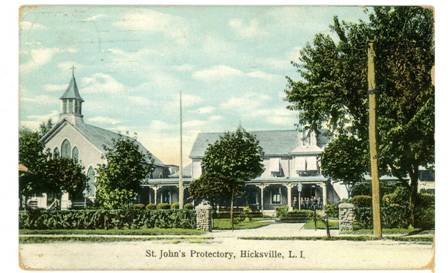
The boys in the Protectory slept in a dormitory, ate together, had classes together - and none of them had family homes to which they could be evacuated. Influenza had reached the institution in early autumn. By New Years, fully half of its boys, and a number of its adults, including the Superintendent, would be suffering from it.
The first Protectory death came in October.
 The Brooklyn Daily Eagle October 16, 1918
Errors are rampant in the account above. So-called Father Schweltz likely is Father Peter Schultz, Pastor of St. John's Home. Could the word "hamm" be a misreading of a sloppily written note, which actually meant to say "mass"? Stranger yet is the reference to the "Church of St. John the Divine" in Hicksville. The ceremony must have been held at St. Ignatius (i.e., from which Pastor Fuchs ministered to the boys at the Protectory for many years). And of course, there is the discrepancy in the article between the deceased's twenty-five and thirty years of service to the boys.
A pity; Sister Bernadine should have been remembered with dignity and appreciation, not with distractions.
To put things into perspective for contemporary readers.... The same issue of the Farmer reported the current epidemic statistics for New York City. The previous day's total for new influenza cases was 4,925. The day's total death count from influenza and pneumonia was 658. The cumulative figures were 42,911 reported cases, and 4,469 deaths. Health officials warned that these numbers understated the reality.
The Daily Long Island Farmer noted that Sister Bernadine had died of influenza. On the same day, it also reported the death of Hicksville's Cpl. Walter S. Wheeler, who had been hospitalized almost immediately upon his regiment's arrival in France. He must have contracted influenza on one of the densely-packed "floating coffin" troop ships, which health officials had urged the government to stop using. After some time in a French hospital, Wheeler died of the pneumonia with which the influenza had left him. Not all of the village's victims would die in Hicksville.
The epidemic would get worse, it then would seem to recede, and a third wave would hit again. It would be a long time until things were normal again - for those who survived.
Woodrow Wilson, Not Explained
Given President Wilson's failure to publicly respond to the first pandemic in modern times, and his failure to follow through on expert advice he was given, it seems prudent to make some observations about him. Warning: Since first learning about him years ago in Hicksville, I have lowered my estimation of Wilson, as soon will be apparent.
He had been a respected academic and administrator, but he was not the typical scholar who published articles on, say, medieval literature or philosophy. He was a student of political science and public policy. He thought himself a visionary who could improve, even reshape, society through government. Thus, he left academia (he was President at Princeton) to become Governor of New Jersey; he next was elected the nation's President. As his status advanced, his aspirations grew accordingly; World War I further magnified his global prestige. Wilson devoted most of his presidency not to domestic matters, but instead to devising plans for the restructuring of a post-war Europe, perhaps even the world, according to his own ideals.
People thought the President a monomaniac, concerned only with the conduct of the war. They were almost correct. He did want a quick victory - but not necessarily to save lives, or to "bring the boys home." Rather, he was in a hurry to begin restructuring Europe and its colonies.
Wilson was a man who clung to his preconceived ideas, even when his advisors warned him of adverse consequences. For example, at Versailles in 1919, he carved up former Ottoman territories in such a way that Sunni and Shia Muslims - deadly enemies, who for centuries had tried to live apart - would be forced to live side-by-side in the same new countries. One imagines the President's thinking, "For Heaven's sake, they're all Arabs, right?"
It should not surprise us that he rejected urgent medical advice he had been given about easing the pandemic. This is not to say that he could have stopped the influenza; that was impossible. But he abused the public's trust severely. He neither ended government practices that led to people's packing themselves together, nor warned the people about the risks they were being encouraged to take. Fate had given Woodrow Wilson his best chance to save American lives, but he had other priorities at the time.
One is tempted to categorize Wilson as a man of ideas, a humanitarian who tried to serve mankind in the abstract. That may be, but he did not seem overly troubled when he allowed the pursuit of his orderly, utopian vision to cost individuals their lives.
Conclusion
Those who served the United States in uniform during World War I believed that their country had gone to war for a reason. They believed that they were serving to help win the war, and that in the struggle, they might be put in mortal peril. They knew that they might be "called upon to die" for the nation's sake.
When the epidemic was reaching its height, statistics quickly confirmed the predictions about crowds with which scientists had warned officials at many levels of government. Yet, unknowing thousands of soldiers still were crammed into troop trains, squeezed too many to a seat as trains traveled to the East Coast. By the time some trains reached their destinations, corpses of young soldiers were stacked in the baggage cars. Similarly, overcrowded troop ships still sailed the Atlantic for a week or more. By the second day out, the first of the dead were being buried at sea. When the ships arrived in England or France, the freshest corpses were unloaded, and the sickest men were brought to hospital wards. The rest of the men, many of them infected and contagious, began their march eastward.
Had these men - had the civilians who were dying only because they had attended rallies or parades - learned that many Mayors and Governors, and certainly their President, had been urged to save their lives just by doing things differently, what would they have thought? That they were being "called upon to die" for the sake of their country?

C. LeRoy Baldridge, Poster for Fourth Liberty
Loan Campaign (Pvt. Treptow's Pledge), 1918
Temple University Libraries,
Digital Exhibits, The War on the Walls
Note: Private Martin Treptow of Wisconsin was
an Army courier, killed by machine guns while
delivering a message. In his pocket diary were
found the words quoted above.
***
Appendix
Scores of wartime reports from Long Island and New York City newspapers served as the basic sources of information for this article. These newspapers are named in the captions and throughout the text above.
In addition, there is an abundance of relevant online resources available; I attempted to limit myself to those which seemed the most reputable. Again, the most relevant of those which I used are shown in the captions.
For information about Russia's contemporary use of Trophy Trains, see this link:
Not for the first time, the revised edition of John Barry's book The Great Influenza provided vivid and stirring accounts of America during the pandemic.
Margaret MacMillian's award-winning Paris 1919, Six Months That Changed the World also was an invaluable source.
If you can stomach more of my writing, the following past Ancient Hixtory articles touch on the World War I / pandemic years:
June 2018: Hicksville flies Service Flags for those who serve, and three Hicksville soldiers die of disease in Europe
1806/hixtory.htm
January 2019: Leading citizens of Hicksville are charged with rioting when a local mob threatens State Troopers (article illustrates anti-German war propaganda and mania)
1901/Hixtory.htm
May 2019: More in-depth accounts of the war, the pandemic, and the three Hicksville soldiers who died in service of their country
1905/Hixtory.htm
I'm still healthy, and I hope that you are. Let's all try to keep it that way.
The 2026 Scholar Apple Sponsorship has officially closed, and the Hicksville community showed up in a big way! According to Ted Urban, in the Hicksville High School Alumni Foundation, Inc. Facebook page, "Together, we covered 75 of the 91 apples - an amazing tribute to the educators and mentors who shape our district." The top 20% of the graduating class will receive an apple at the Scholars Dinner. The Hicksville Council of PTAs wrote on Facebook, "Your generosity helps recognize and celebrate our scholars in a meaningful way. Thank you for always showing up for our students and for making our community so special."
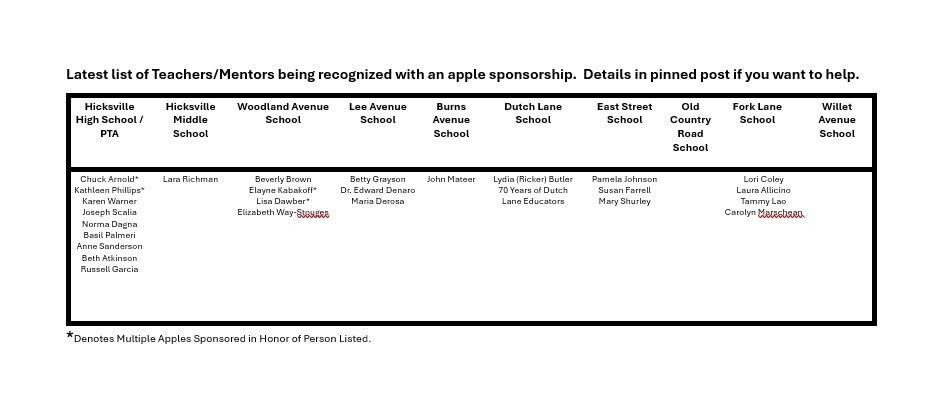
Etcetera for March 2026
Hicksville High School Class of 1977 – 50th Reunion (2027!)
Can you believe it?! Our 50th Reunion is coming up in 2027! 🎓🖤🧡
We are in the early planning stages and are gauging interest before locking in dates and venues. We’re currently considering dates between June and September 2027. The planning team has created a survey to help us plan. Please complete the form:
https://forms.gle/nyssxnG7qfWsZwF57
This reunion will be what we make it — and we’d love to celebrate together! 🥂
Please also help us spread the word by inviting classmates who may not yet be in this group.
Here’s to 50 years, friendships, memories, and making new ones! 💫
— Your Reunion Planning Committee (editor's note: You can also follow on Facebook at Hicksville High School Class of '77)
In Memoriam
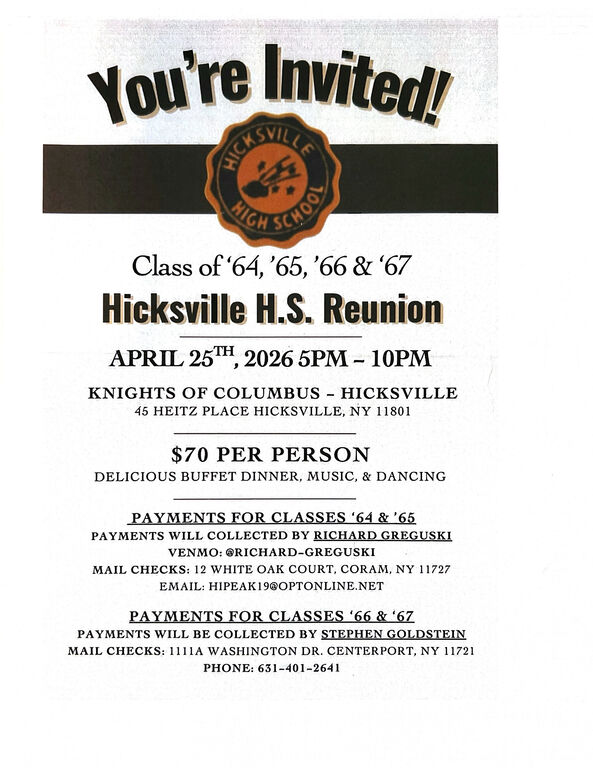
Email Received: This is Ann Schwartz Arroyo, class of 1965. I have been working with a group to have a 60th reunion for our class. By joining with 3 other classes, we have enough Hicksville alums for the reunion in April. I have been assigned to make a memorial board up for the class of ‘65. Reviewing the Hix News list, I wanted to add more ‘65 alumni who have passed: Ida Peloso, Steven Peltz, Myra Rosen, Armand Sepanski, Kenneth Kudrick, and Mary DeFelice (Editor's note: Names have been added. If you have an obituary, please email
Chief William Edward "Spike" Thunell, Class of 1964, passed March 5, 2026
Mary Francis McGuire, Class of 1979, passed March 5, 2026
Barbara Ellen Hoye, Class of 1971, passed April 2025
John Glynn, Class of 1973, passed 2025
Delores Vatier Ahern, Class of 1962, passed March 4, 2026