
The Hospital is Born, Forcibly Adopted, and Returned to Its Parents
Per the plans made before departure, Mary Gladwin continued to lead as Hospital Supervisor, with young Dr. Edward W. Ryan aiding her as Chief Surgeon. The nurses were each allocated responsibility for certain wards. Given the anticipated number of casualties, wards were set up not only in the buildings, but also in the open pavilions that connected them. Mary Keller became Night Supervisor for the entire hospital.
Healing and saving people in a city under constant attack proved to be as demanding as imagined. The hospital was for everyone, whether civilian or military. During November, Austro-Hungarian forces advanced, and wounded men from both armies were brought to the hospital. Later in November, things looked so grim for Serbia that it ordered Belgrade evacuated. It was expected that invaders might single out wealthy and high-ranking enemy civilians and their families, so the British and Serbian hospital administrators left-but before going, they appointed Dr. Ryan as Chief Surgeon for all the hospitals in Belgrade.
On December 2, Austria-Hungary officially took control of the city, including the American Red Cross Hospital. Its doctors brought their own instruments and regimens with them, but things went surprisingly well despite their also bringing with them a backlog of thousands of Austro-Hungarian casualties. The hospital was crowded, which was good: a great many people in need were being helped.
Less than two weeks later, Mary Keller was on night duty when all “The Austrians” (as the Americans called the new doctors) arrived unexpectedly. They had come to collect their medical instruments and personal items, because Austria-Hungary was abandoning Belgrade! Keller awoke Mary Gladwin to alert her. The vast Empire had overextended itself, stretching its armies unsustainably thin. Typhus (not treatable, often fatal) was spreading among the starving troops. The armies would retreat; the doctors would flee Belgrade before the Serbs could capture them.
On December 15, beloved King Peter made a triumphant return to the city, cheered by many returning Serbs. This “Return of the King” scene was spoiled only by the unspoken thought that the artillery barrages might resume later.
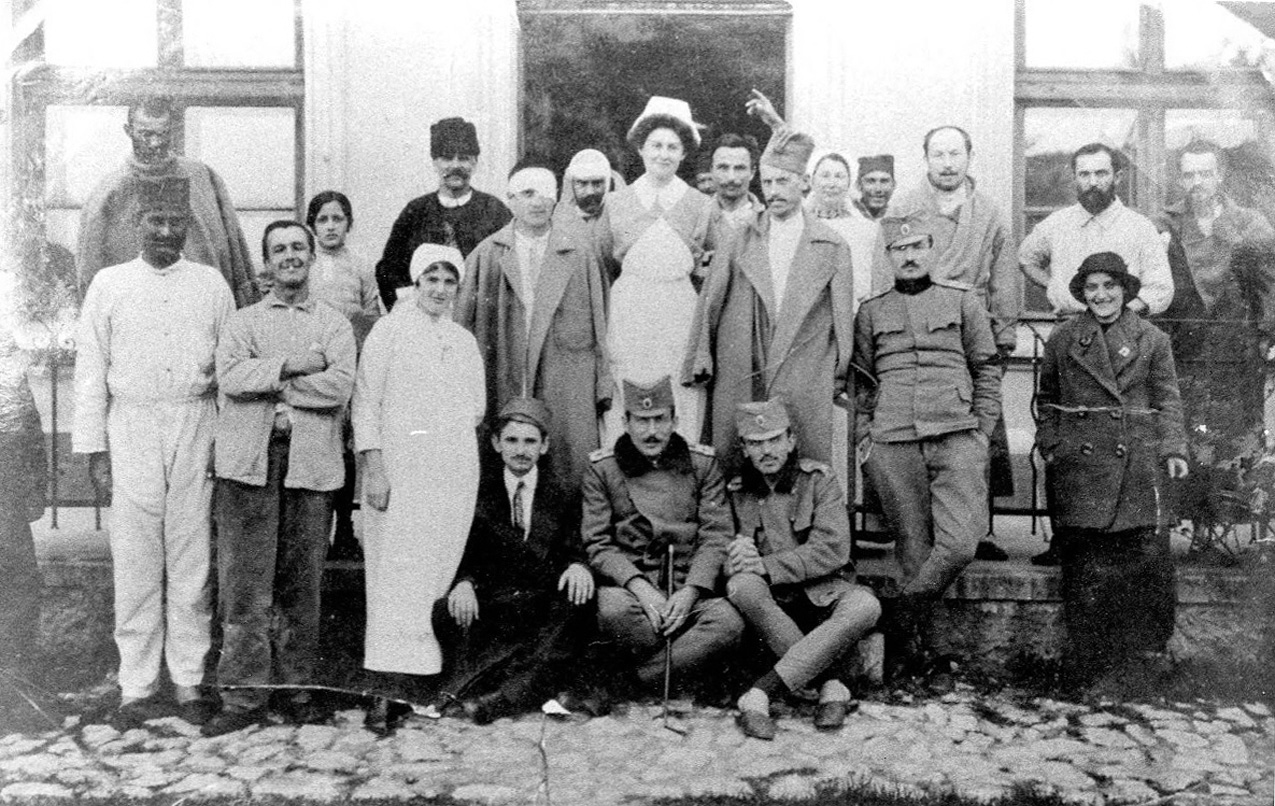 Mary Frances Keller in her domain, with wounded patients, fellow nurses, aides,
orderlies, and perhaps a priest and a doctor or two
(see FOOTNOTE at the bottom of this page)
During one prolonged break in the shelling, Mary Gladwin wrote that the silence was as unsettling as the shelling. She envied “Nurse Keller,” who said that she fell asleep more easily during the shelling than the pauses. I don’t know whether this picture was taken during such a pause, or after “the Austrians” had left, but it does not reflect any of the terror which all these people must have experienced during the barrages. They all look just happy to be alive. People are resilient.
When Red Cross Dr. Edward Ryan finally left Belgrade, he took with him some souvenirs of his stay, including a "dud" incoming artillery shell. His next project was in Hungary; when moving his luggage through the main Budapest railway station, the luggage cart toppled over, and his souvenir shall detonated, causing much damage. He was uninjured, but he was angrily interrogated for quite a while.
FOOTNOTE: The above photograph originally included inscription (shown below) made along the bottom edge by the anonymous photographer. Enough of her/his notes survive to be conclusive.

By flipping the notes right-to-left and filling in the most obvious blanks, you get this:
Belgrade/American [Re?]d Cross/???????? M. F. Keller in c???
How was this annotation written on the film?
In 1914, Eastman Kodak acquired a patent for making special film and cameras that allowed people to write in the gaps between images while they took pictures. Kodak called this feature “Autographic.” Below is a very early ad for these cameras, from National Geographic for September 1914. Note that this was the latest issue of the magazine available when Mary and her fellow nurses set sail for Europe.
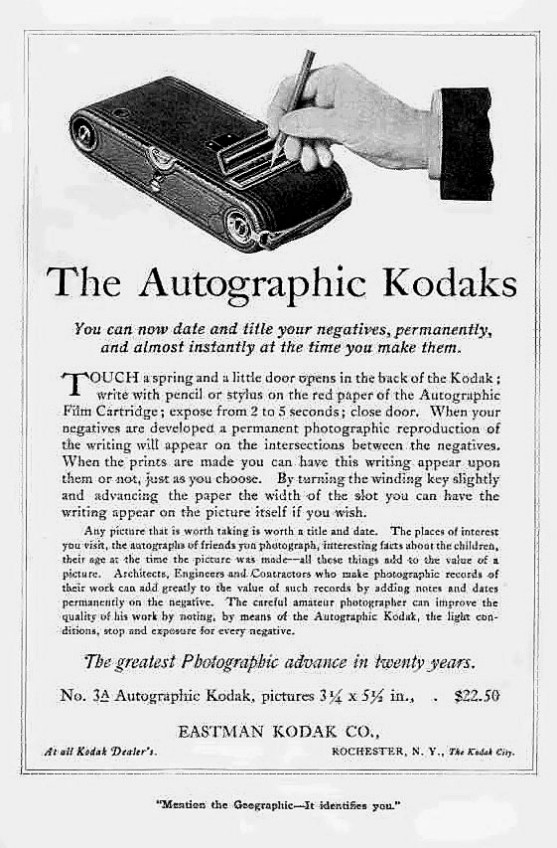
You opened a little compartment on the back of the camera, and used a special stylus (it came with the camera) to write on the opaque red paper inside. As you wrote, the tip of the stylus pushed the film against carbon paper. When you were done writing, you lifted up the opaque paper for a few seconds to expose the rectangle of film with the carbon copy of your written words. When the film was developed later, the writing would be adjacent to the picture.
This was a great way for photographers to keep track of the place, date, subject, lens and shutter settings, etc. for every picture taken, but it was not necessarily what the public wanted. Why? Because the public wanted to see prints, and when prints were made, the Autographic writing was a mirror image of what was originally written, as we saw above on the picture from Belgrade. There are reports that some professional photographers learned to write backwards to avoid this problem, but the public wasn’t going to do that.
Public interest in Autographic cameras soon waned, and Kodak discontinued them when the Great Depression hit hard in 1932. Too bad; historians could use more pictures that spoke to them in words.