
 We are reprinting Ron Wencer's article about Mary Keller, Part 2, which includes new information about a photograph on page 6, along with a fascinating footnote. We are pleased to include another episode of Where Are They Now?, featuring Hal Blackman from the Class of 1977. We think you will find his story fascinating and helpful! Last month, we asked those who served to email us. Our webmaster created a new section under Honoring our Vets, where you will see Our Veterans' Stories. Please continue to send us your information so we can add you to this section. Or, if you are already a website member, you can create your story as a Personal Blog. Email us at
View The Hix News Team
Contributing Writers:
This email address is being protected from spambots. You need JavaScript enabled to view it. - '64, Where are They NowThis email address is being protected from spambots. You need JavaScript enabled to view it. - '77, My Memories- Karl Schweitzer - '81, The Hicksville Connection
- Thomas Connolly - '74, Financial Conversations
- Joseph Platt - '64
- John Maniec - '64
Editors:
This email address is being protected from spambots. You need JavaScript enabled to view it. - '77This email address is being protected from spambots. You need JavaScript enabled to view it. - 77
Webmasters:
This email address is being protected from spambots. You need JavaScript enabled to view it. (spouse of Eileen Goldstein - '77)
Web Development and IT:
This email address is being protected from spambots. You need JavaScript enabled to view it. - '08
Editors Emeritus:
- David J. Rubin - '82
- Elliot Gorlin - '63
- Valerie Pakaluk - '51
- Henry Lichtenstein - '59
- Marc Malamud - '77
Founding Editors:
- Pat (Koziuk) Driscoll - '56
- Linda (Piccerelli) Hayden - '60
- Buffalo Bob Casale - '61
Founding Webmaster:
- Roger Whitaker
Introduction
Last month’s Hixnews recounted how Hicksville nurse Mary Keller, who would later serve in the U.S. Army Nurse Corps during World War I, crossed the Atlantic in September 1914. Bound for Belgrade, then under bombardment, she was part of a medical team that would create an American Red Cross Hospital to treat wartime casualties. Developments in Europe interrupted their journey, and as October began, the team found itself shipless in Athens.
Anchors Aweigh, Again
Given the wartime conditions, new travel arrangements would not congeal immediately. Meanwhile, the nurses and doctors shopped for flea powder and other niceties, and they toured the Acropolis together. On the evening of October 6, they were able to board a ship bound for Thessaloniki/Salonica. Apparently, the ship was better than the last one, as the diary of Team Leader Mary Gladwin scarcely says anything about it.
Sailing north, its prime objective was to not attract the attention of Austro-Hungarian warships in the Aegean Sea. Wartime boarding parties might be tempted to not respect Red Cross neutrality; they might seize medical supplies, or even a doctor or nurse. Thus, the medical team’s ship would follow an arduous route - please see the annotated 1914 map in this article - hoping to avoid warships’ notice by not sailing in the middle of the Aegean.
Today, we think of Austria as landlocked and mountainous, but its past empire had extended to the Adriatic Sea, from which Austrian frigates fought battles against those of other European powers to keep the Mediterranean open to Austrian shipping.

Looking at the map, we see that the route went from A (Athens) to T (Thessaloniki), first via the Euborean Gulf - more a strait than a gulf - a natural inland waterway, with entry points too narrow to permit large warships from using it. The gulf was safe, in that ships traveling in it could not be seen from the Aegean, but it is infamous for its dangerous currents, which change direction abruptly and batter ships. Mary Gladwin wrote that she was horribly seasick on this leg of the trip. After exiting the gulf, the ship probably hugged the shore the rest of the way. Distant warships were seen, but they did not bother to approach it. Thessaloniki was reached without incident on October 9; the rest of the journey would be made overland: mostly by rail, sometimes by horse-drawn carriage, and once even by ox cart!
Destination Somewhat Unknown
Belgrade lies on the Sava River, which in 1914 was Serbia’s northern boundary with Austro-Hungarian territory. The bombardment had first come from the river, not from the other side. The Empire had a flotilla of river-sized warships, with firepower roughly equivalent to that of some modern tanks.
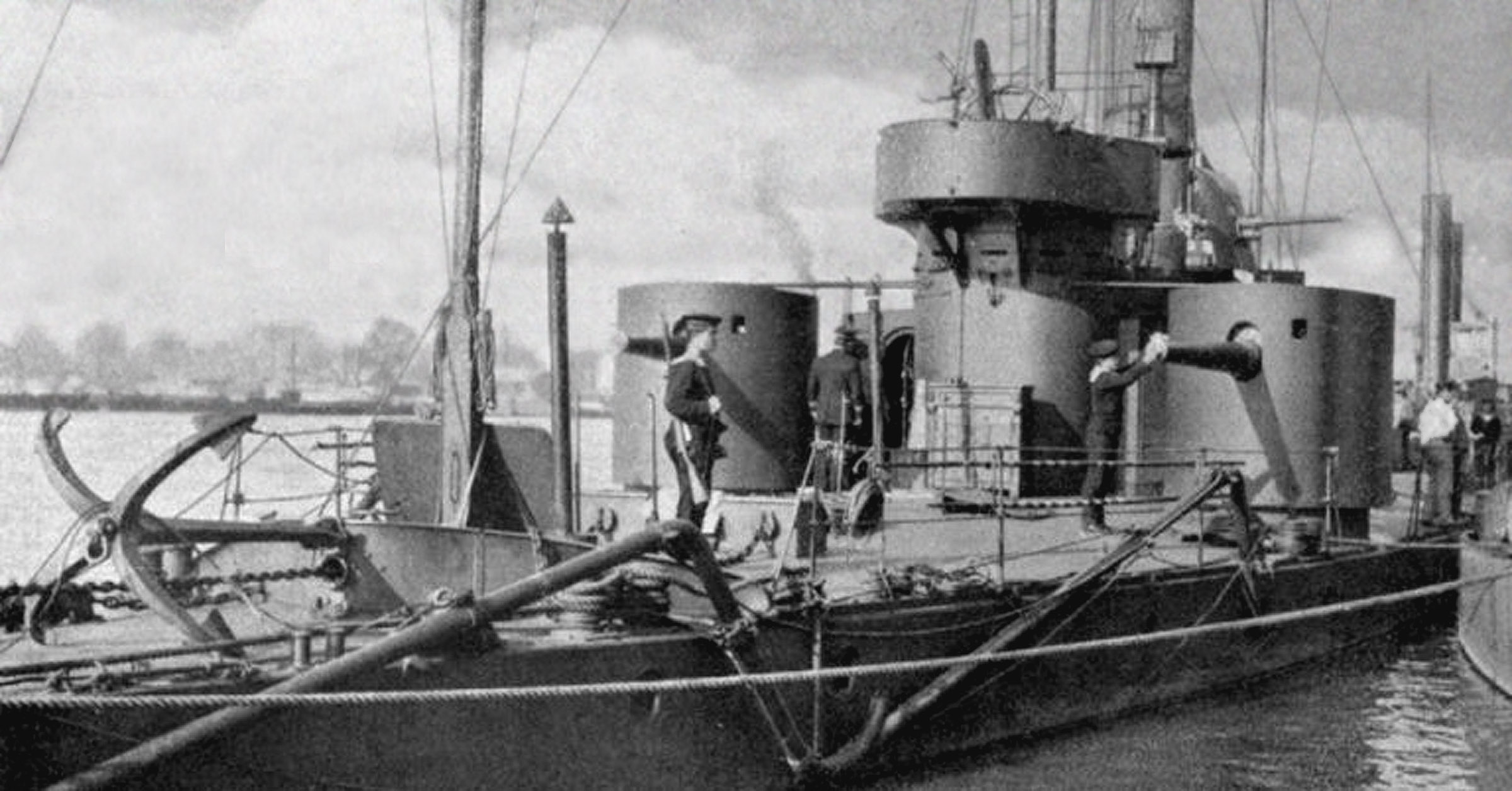 SMS Bodrog being refueled; this is the ship that fired the first salvo of World War I
The bombardments hit not only military or government targets. Shells seemed to strike anywhere: shops, streets, homes, offices, hospitals, etc. As time went by, mortars and howitzers were set up inland, several miles north of the river. These guns would thereafter carry the burden of the attack, sending bigger, more destructive shells into Belgrade. In response, the Serbian government relocated further south, primarily to the city of Nish, and it also distributed some of its functions among smaller cities and towns. Even as Mary Keller and her peers worked their way north, the government in Nish was reevaluating the decision to put the new hospital in Belgrade.
At Nish, the Americans left the train and traveled around the region for four days, conferring with a number of officials of the Serbian Red Cross and government in their new locations. Talking with them, seeing rural Serbs in their traditional dress and centuries-old homes, and partaking of some of the local customs, the nurses and doctors began to gain an understanding of Serbs as a people. Once the hospital was functioning, that understanding would remind them that their patients were not truly anonymous. They might differ from Americans, but the patients were simply people, much like the good people they had met on this trip, but people who had been drawn into the Great War.
The Crown Prince
On October 14, they continued on to Valjevo (V on the map), where they were formally presented at a reception to the dashing Crown Prince Alexander, regent and de facto leader of Serbia. They also met his elderly father, King Peter, who because of his age had recused himself from wartime duties, but who occasionally still made ceremonial appearances.
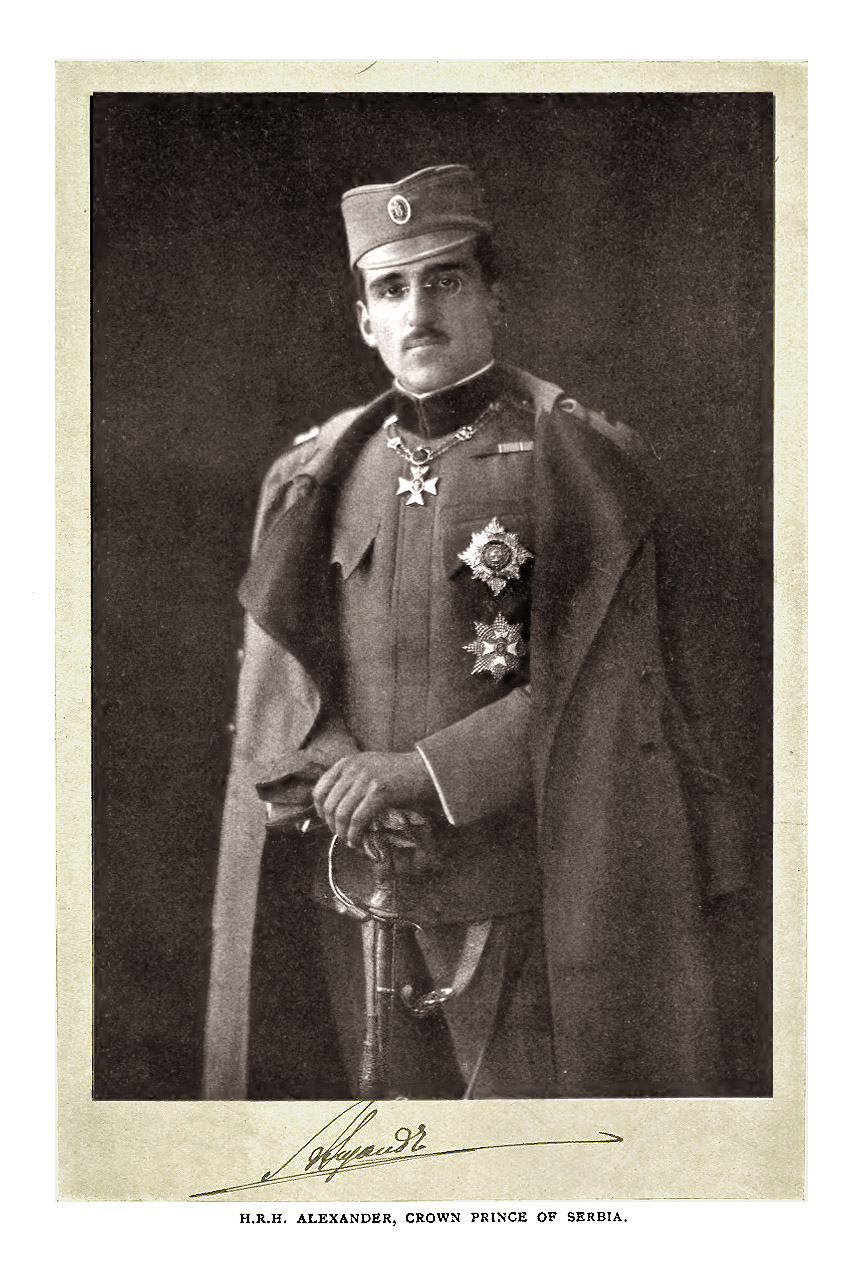
At the reception, Alexander raised the possibility of the Americans setting up their hospital somewhere safer than Belgrade, but the Red Cross group declined his offer, saying that they all had resolved to face the dangers before sailing from New York. Showing only a little surprise, the Prince accepted their decision, and he authorized their use of a complex in Belgrade that had been erected c.1908 for use as a military hospital. Its nine buildings were suitable, although not furnished with a full complement of modern medical equipment. Hypothetically, this was a shortcoming, but even if it was, it was irrelevant. There was no electric power anywhere in Belgrade, thanks to the continuing bombardment, so new electrically powered equipment would be useless.
And so, the following morning, the Americans emerged from their overnight train, five full weeks after departing from New York, but they were not quite in Belgrade. The main railway station, and the rails leading to it, had been rendered unusable by artillery shells. To make things worse, it was raining, as it had rained for the eight preceding days. As their wagons slogged several miles through the mud, the newcomers faced an oncoming swell of refugees who were fleeing Belgrade; the people they saw carried wooden chairs, cradles, and other poignant remnants of their forsaken homes.
The Hospital is Born, Forcibly Adopted, and Returned to Its Parents
Per the plans made before departure, Mary Gladwin continued to lead as Hospital Supervisor, with young Dr. Edward W. Ryan aiding her as Chief Surgeon. The nurses were each allocated responsibility for certain wards. Given the anticipated number of casualties, wards were set up not only in the buildings, but also in the open pavilions that connected them. Mary Keller became Night Supervisor for the entire hospital.
Healing and saving people in a city under constant attack proved to be as demanding as imagined. The hospital was for everyone, whether civilian or military. During November, Austro-Hungarian forces advanced, and wounded men from both armies were brought to the hospital. Later in November, things looked so grim for Serbia that it ordered Belgrade evacuated. It was expected that invaders might single out wealthy and high-ranking enemy civilians and their families, so the British and Serbian hospital administrators left-but before going, they appointed Dr. Ryan as Chief Surgeon for all the hospitals in Belgrade.
On December 2, Austria-Hungary officially took control of the city, including the American Red Cross Hospital. Its doctors brought their own instruments and regimens with them, but things went surprisingly well despite their also bringing with them a backlog of thousands of Austro-Hungarian casualties. The hospital was crowded, which was good: a great many people in need were being helped.
Less than two weeks later, Mary Keller was on night duty when all “The Austrians” (as the Americans called the new doctors) arrived unexpectedly. They had come to collect their medical instruments and personal items, because Austria-Hungary was abandoning Belgrade! Keller awoke Mary Gladwin to alert her. The vast Empire had overextended itself, stretching its armies unsustainably thin. Typhus (not treatable, often fatal) was spreading among the starving troops. The armies would retreat; the doctors would flee Belgrade before the Serbs could capture them.
On December 15, beloved King Peter made a triumphant return to the city, cheered by many returning Serbs. This “Return of the King” scene was spoiled only by the unspoken thought that the artillery barrages might resume later.
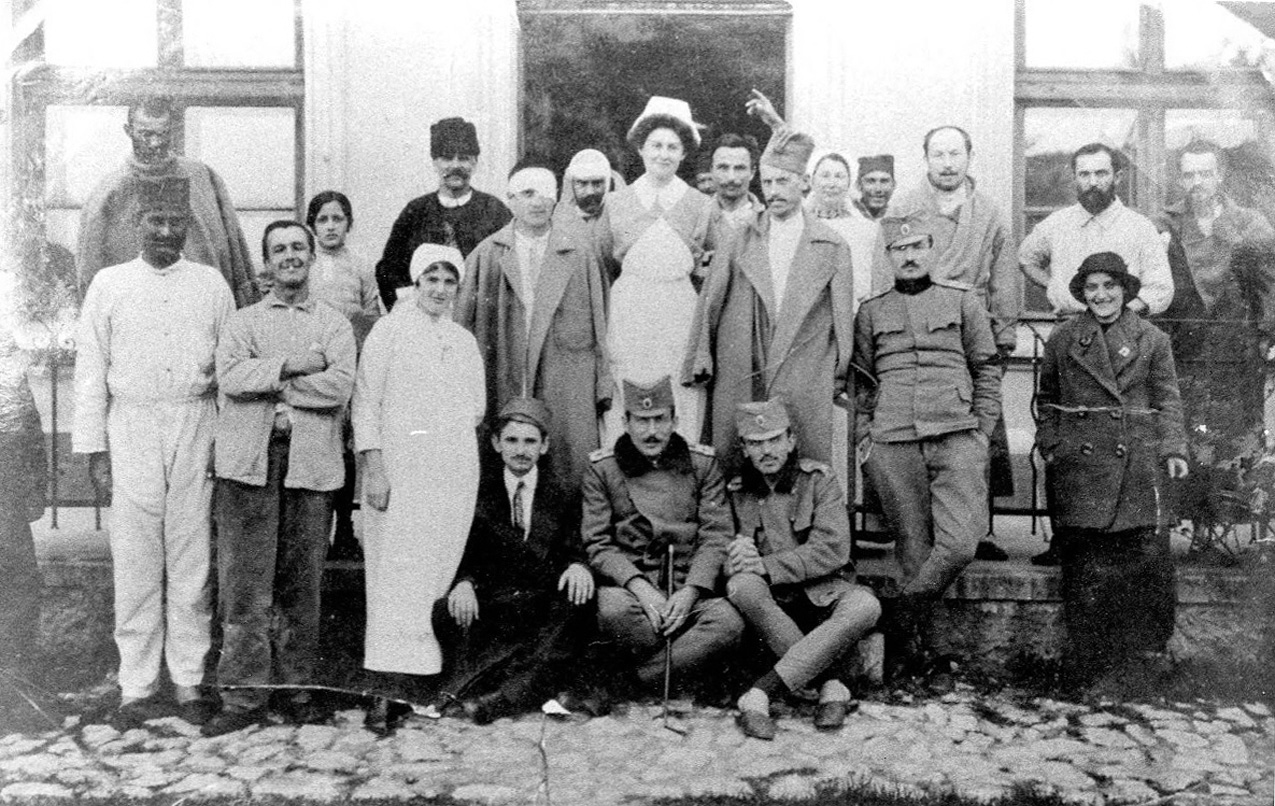 Mary Frances Keller in her domain, with wounded patients, fellow nurses, aides,
orderlies, and perhaps a priest and a doctor or two
(see FOOTNOTE at the bottom of this page)
During one prolonged break in the shelling, Mary Gladwin wrote that the silence was as unsettling as the shelling. She envied “Nurse Keller,” who said that she fell asleep more easily during the shelling than the pauses. I don’t know whether this picture was taken during such a pause, or after “the Austrians” had left, but it does not reflect any of the terror which all these people must have experienced during the barrages. They all look just happy to be alive. People are resilient.
When Red Cross Dr. Edward Ryan finally left Belgrade, he took with him some souvenirs of his stay, including a "dud" incoming artillery shell. His next project was in Hungary; when moving his luggage through the main Budapest railway station, the luggage cart toppled over, and his souvenir shall detonated, causing much damage. He was uninjured, but he was angrily interrogated for quite a while.
FOOTNOTE: The above photograph originally included inscription (shown below) made along the bottom edge by the anonymous photographer. Enough of her/his notes survive to be conclusive.

By flipping the notes right-to-left and filling in the most obvious blanks, you get this:
Belgrade/American [Re?]d Cross/???????? M. F. Keller in c???
How was this annotation written on the film?
In 1914, Eastman Kodak acquired a patent for making special film and cameras that allowed people to write in the gaps between images while they took pictures. Kodak called this feature “Autographic.” Below is a very early ad for these cameras, from National Geographic for September 1914. Note that this was the latest issue of the magazine available when Mary and her fellow nurses set sail for Europe.
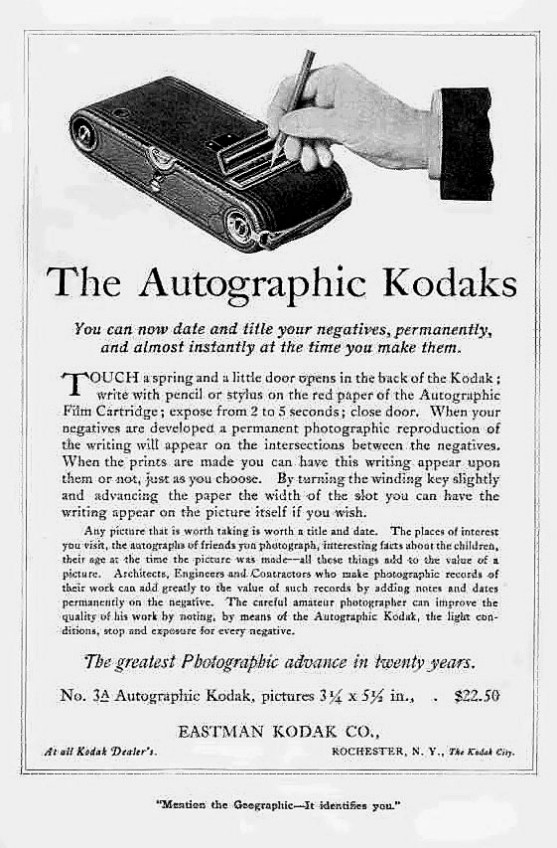
You opened a little compartment on the back of the camera, and used a special stylus (it came with the camera) to write on the opaque red paper inside. As you wrote, the tip of the stylus pushed the film against carbon paper. When you were done writing, you lifted up the opaque paper for a few seconds to expose the rectangle of film with the carbon copy of your written words. When the film was developed later, the writing would be adjacent to the picture.
This was a great way for photographers to keep track of the place, date, subject, lens and shutter settings, etc. for every picture taken, but it was not necessarily what the public wanted. Why? Because the public wanted to see prints, and when prints were made, the Autographic writing was a mirror image of what was originally written, as we saw above on the picture from Belgrade. There are reports that some professional photographers learned to write backwards to avoid this problem, but the public wasn’t going to do that.
Public interest in Autographic cameras soon waned, and Kodak discontinued them when the Great Depression hit hard in 1932. Too bad; historians could use more pictures that spoke to them in words.
Typhus
As the winter of 1914-1915 deepened, typhus spread across Serbia, especially in the ranks of the armies. The daily caseload at the American Red Cross Hospital surpassed 9,000 patients. Patients sometimes had to share beds. In early Spring, some patients were bundled up and put in beds in the open courtyard, the hospital thereby learning that the courtyard had a capacity of 3,000 patients. With the advent of warm weather, the epidemic finally receded.
It is no surprise that a number of staff at the hospital contracted typhus. Two of the original American nurses got it, as did Dr. Ryan. More nurses had arrived from America, and some of them caught it. Two nurses reportedly died from it, although this has proved hard to confirm. While Dr. Ryan was trying to fight it off, he was replaced as Chief Surgeon by Dr. Ernest Magruder, who had been sent from the U.S. to Serbia to study the epidemic. Ironically, soon after stepping into Ryan’s role, Magruder himself died of typhus, becoming the second American Red Cross surgeon to die of it in Serbia.
Dr. Ryan eventually made a full recovery. He continued to work in Serbia well into 1916, and went on to serve until his early death with the American Red Cross abroad. In 2018, a Serbian postage stamp commemorated his service to the country:
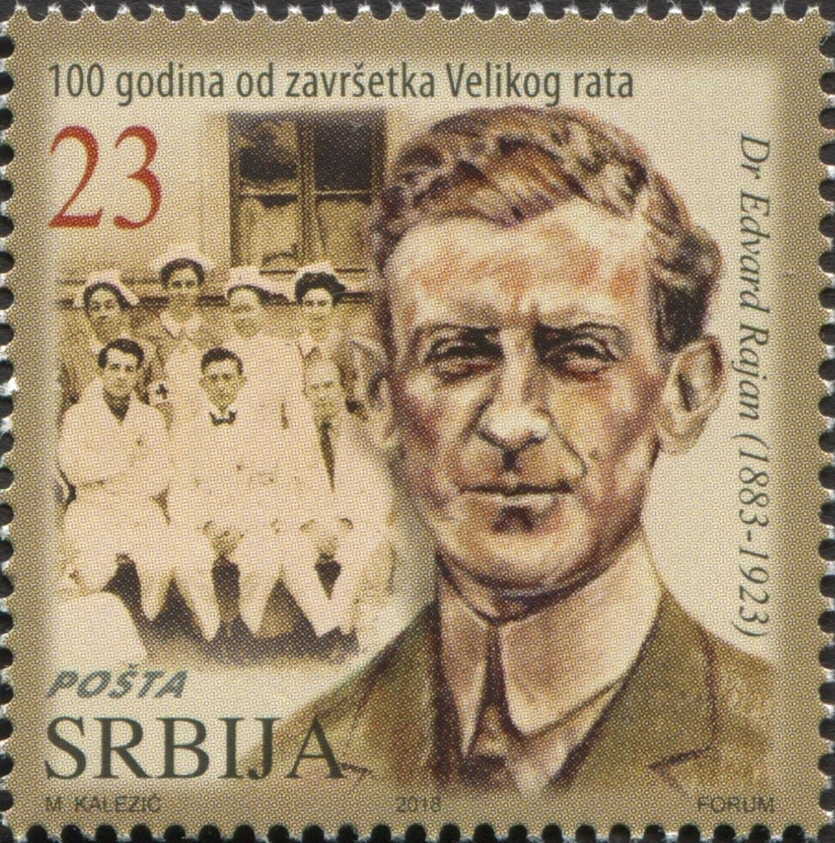
BTW, in the background photo on the stamp, Ryan is sporting a bow tie, and the high-foreheaded nurse standing behind his left shoulder is Mary Gladwin.
A June Departure with Plenty of Tea
Keller appears to have left Belgrade in June 1915; she had remained on duty there longer than her intended six-month term. Agnes Gardner, another of the original nurses, wrote that the ten American nurses who left that June traveled together:
“We joined Sir Thomas Lipton's yacht, the Erin, at Salonique [sic], making a delightful trip to Naples; from there we took an Italian steamer homeward, after many months spent in a country among people who love the American sisters and will long remember our efforts to alleviate their sufferings.”
Once back in Hicksville, Nurse Keller encouraged people to support the Red Cross, speaking to the high school’s students about her experiences in Serbia. She later agreed to be drafted from the Red Cross into the Army Nurse Corps, from which she returned to Hicksville in 1919, just in time for the July 4th post-War celebrations.
Mary Frances Keller packed a lot of service and accomplishment into one life, a life which I am not yet prepared to say that I have finished researching. I will not be surprised by anything more that I learn about this amazing person.
Sources
Images, etc. in Part 1
The article’s “Title Block” contains a photo of Mary Keller that was digitally extracted and reworked from a family portrait in the Keller Family Collection, found online in the Hicksville Public Library’s digital images. For the image of the ship Ioaninna, see below.
“Miss Keller to Accompany Servian Unit” appeared in the Brooklyn Daily Eagle for September 4, 1914.
The picture of St. Mary’s Hospital is from the digital collection of the Brooklyn Public Library.
The image of Woman’s Hospital, New York is from Ebay; the original postcard was published c.1906 by Albertype Company.
This photo of S.S. Ioaninna is from uboat-net, a website that commemorates the careers of German submarine officers, tracking how and where they sank ships, how many lives were lost, etc. I don’t think I want to understand why someone would maintain such a website, but from it one learns that the Ioaninna was sunk in the eastern Atlantic in 1917 by a uboat. I’ll not risk perpetuating the submarine’s fame, nor that of its captain, by naming them here. Presumably all of those then aboard the Ioaninna perished. May they rest in peace.
The photo of HMS Glory comes from the George Grantham Bain Collection at the Library of Congress.
The postcard of the Corinth Canal is from ebay; the publisher is unknown.
Pages from Mary Gladwin’s diary can be found in various locations online, often not in correct sequence, or automatically scanned with uncorrected errors. Excellent images of the original can be found in the “World War I in Ohio Collection” of the Ohio History Connection, starting at ohiomemory.org/digital/collection/p16007coll51/id/3402
Images, etc. in Part 2
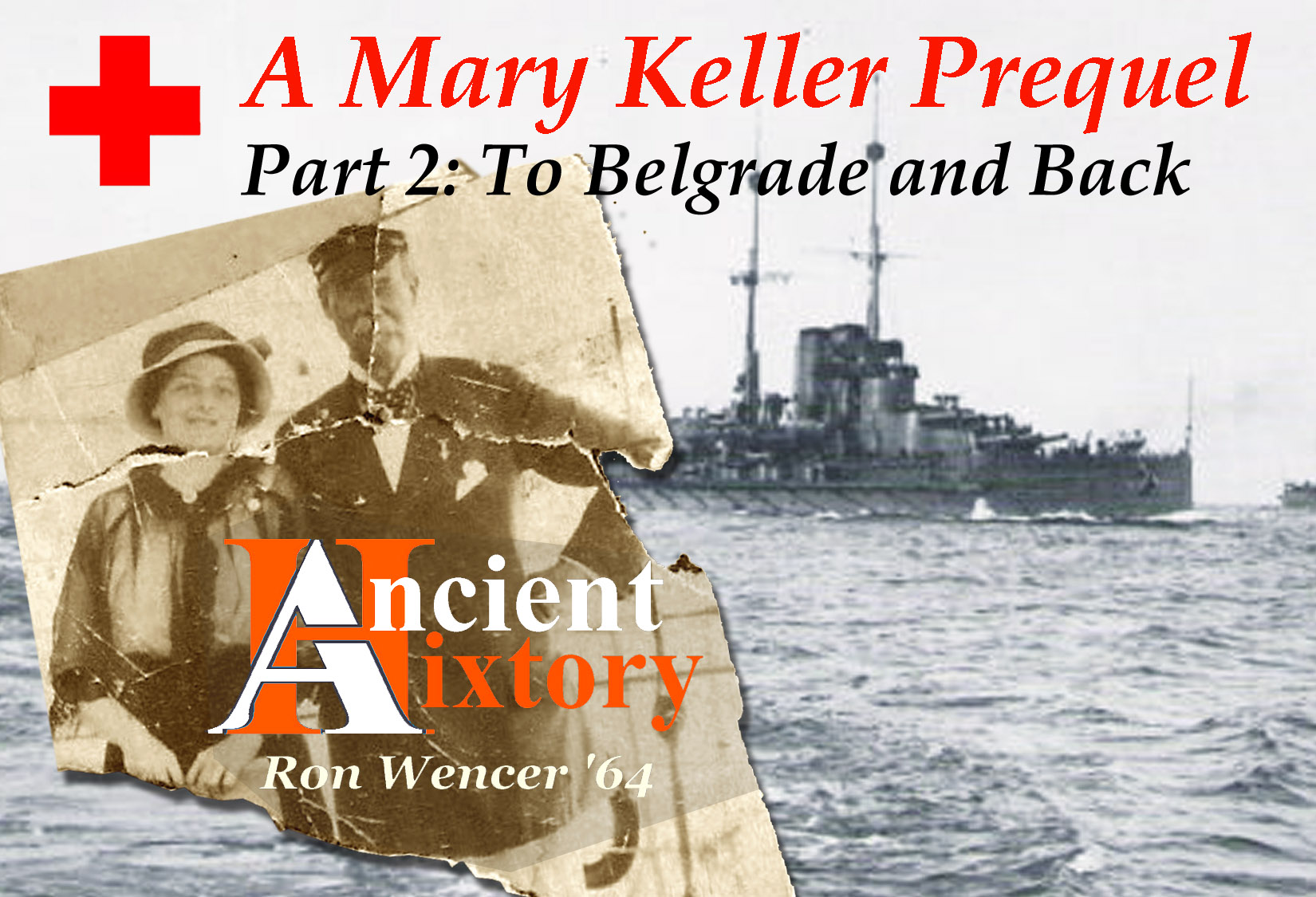
Two “Title Block” images need credits. The Keller Family Collection in the Hicksville Public Library’s digital images is the source of a tattered picture-only one piece of which is used here-of Mary Keller with Scottish yachtsman, philanthropist, and tea merchant Sir Thomas Lipton. He spent a lot of time in Serbia during the War, visiting hospitals to bring medical supplies, and poor villages to provide food when it was scarce. The “background” for the block is from Wikipedia; it shows some of the Austro-Hungarian fleet that the Red Cross team managed to evade.
The map of the southern Balkan region and Greece is extracted and annotated from an excellent 1914 map preserved digitally at World War I Today (wwitoday.com)
The picture of SMS Bodrog is from www.warhistoryonline.com
The portrait of Crown Prince Alexander is from “The Story of a Red Cross Unit in Serbia” by Berry, Dickinson, and Blease, et al, 1916; accessed from the Internet Archive.
The group photo outside the hospital is also from The Keller Family Collection within the Hicksville Public Library’s digital images.
The Serbian postage stamp is from Wikimedia Commons.
The quotation from Nurse Gardner is from her article “American Red Cross Work in Serbia” in The American Journal of Nursing for October 1915, available online at JSTOR.
That’s It for Now!
Holiday Happenings
by Wendy Elkis Girnis
Class of 1977
Welcome to the Holiday Season. When we think of December, we think of snow, celebrations, Santa, lit menorahs, and kinaras. There are many holidays taking place. There are also many festivities and celebrations taking place in and around Hicksville. Let’s mark down some of these in our calendars.
December Celebrations
- Monday, December 8: Bodhi Day (Buddhism) - Also called Buddha’s Enlightenment Day, it commemorates when Siddhartha Gautama attained awakening — or enlightenment — some 2,600 years ago, becoming the Buddha. It is a day of prayer, meditation, chanting, and reading the scriptures (Sutras).
- Contact local Buddhist centers on Long Island for a list of events

- Friday, December 12: Our Lady of Guadalupe Day (Christianity) - A Catholic holiday celebrated on December 12th to commemorate the Virgin Mary's appearance to Juan Diego in 1531.
- Check with your local Catholic Church for special events.

- Tuesday, December 16 – Wednesday, December 24: Las Posadas (Mexican/Southwestern US Christianity) - A Mexican Christmas tradition that commemorates Mary and Joseph's journey to Bethlehem and is celebrated with processions, singing, and piñatas.
- For activities, check out this website: https://www.twinkl.com/event/las-posadas-usa-2025

- Sunday, December 21 – Monday, January 1: Yule (Pagan)- Celebrates the winter solstice, the shortest day of the year, and the rebirth of the sun. - Celebrate Yule, with a Solstice Hike
- Contact your local state or county parks for a listing of times and places.

- Thursday, December 25: Christmas Day (Christianity)- Celebrates the birth of Jesus Christ, who Christians believe is the Son of God.
- Santa will be at the Broadway Commons until December 24th- https://atbroadwaycommons.com/events/photos-with-santa/
- Christmas House Long Island is open at the Broadway Commons- Christmas House Long Island is an indoor, one-of-a-kind, fully immersive Christmas experience! https://christmashouselongisland.com/
- Sunday, December 14– Monday, December 22: Chanukah (Judaism) - Celebrates the rededication of the Second Temple in Jerusalem after a Jewish victory against the Greek-Syrian Empire in the 2nd century BC.
- Check out some family-friendly events here: https://www.newyorkfamily.com/family-friendly-hanukkah-events-long-island/
- Friday, December 26: St. Stephen’s Day (Boxing Day) (Christianity) - Commemorates the life of St Stephen, a Christian deacon in Jerusalem who was known for his service to the poor and his status as the first Christian martyr. This holiday is celebrated by giving to charity, church services, and feasting.
- Check with British or Caribbean cultural centers for any upcoming events.
- Friday, December 26 – Thursday, January 1: Kwanzaa (Pan-African) - Kwanzaa is a week-long holiday that celebrates African American culture and heritage.
- Long Island Children’s Museum, Garden City, December 30, 1 p.m.-3 p.m.
- Learn about the holiday's meaning and traditions, make a mkeka (traditional mat) craft, and a beaded ear of corn https://www.licm.org/calendar/event/celebrate-kwanzaa-2025/
- Tuesday, January 6 : Three Kings Day (Epiphany) - Three Kings Day, or El Dia de Reyes, is an important holiday for Catholics. In addition to gift-giving, there is also a holiday dessert known as Rosca de Reyes (King’s Cake). Shaped in a circle to signify a king’s crown, this sweet bread holds a special surprise. Inside is a small plastic figurine representing the baby Jesus. Whoever finds this token is obligated to host an upcoming party for the occasion Dia de la Condelaria (Candlemas Day), which occurs each year on February 2.

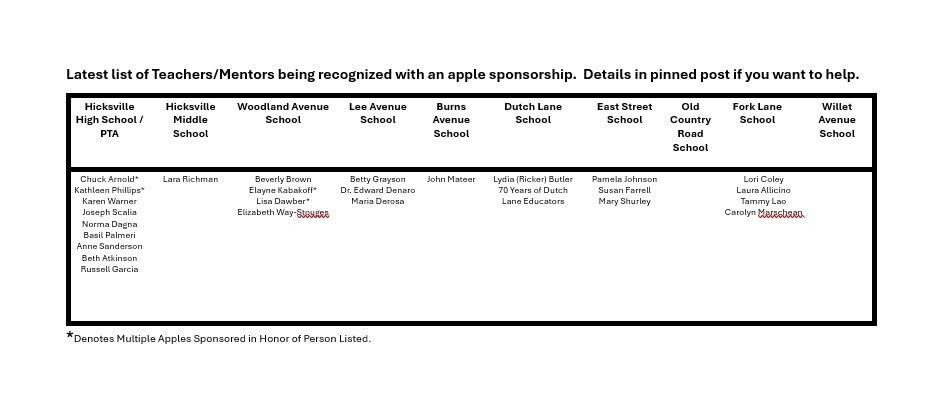
The 2026 Scholar Apple Sponsorship has officially closed, and the Hicksville community showed up in a big way! According to Ted Urban, in the Hicksville High School Alumni Foundation, Inc. Facebook page, "Together, we covered 75 of the 91 apples - an amazing tribute to the educators and mentors who shape our district." The top 20% of the graduating class will receive an apple at the Scholars Dinner. The Hicksville Council of PTAs wrote on Facebook, "Your generosity helps recognize and celebrate our scholars in a meaningful way. Thank you for always showing up for our students and for making our community so special."
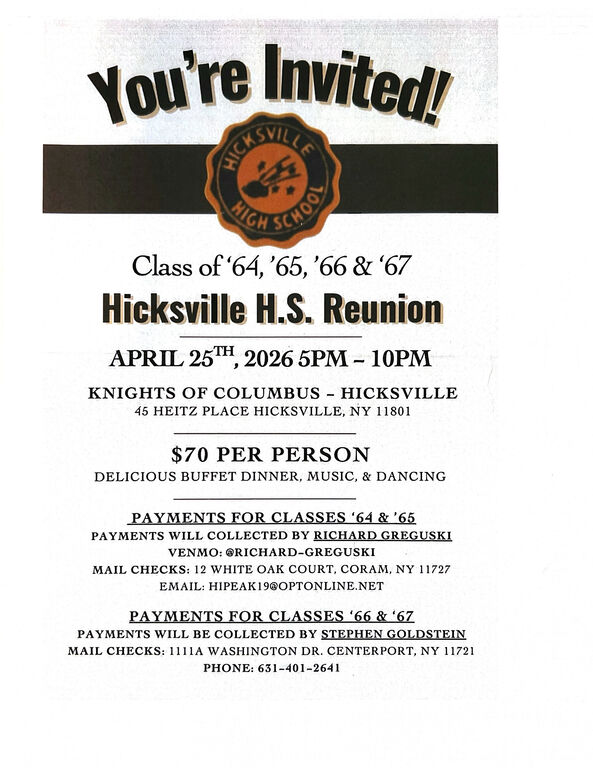
Etcetera for December 2025
House of Donuts fundraiser update
In the October 2025 issue, we wrote about the fire at House of Donuts. To date, $ 44,617 of the $45,000 goal has been raised from 639 donations. The link is https://gofund.me/b8abbf130
In Memoriam
William "Bill" George Brock, Class of 1966, passed Nov. 13, 2025
Our Veterans' Stories
Thank you to Wayne Lyons (Class of 1966) for his submission! Take time to go to Members, Me, New Blog to add your own story. Click here for a link to Wayne's story on Hixnews.com.
The following comments on various articles have been recently posted by site members. Click on a title if you want to read the comment and/or join the discussion.