
 Introduction
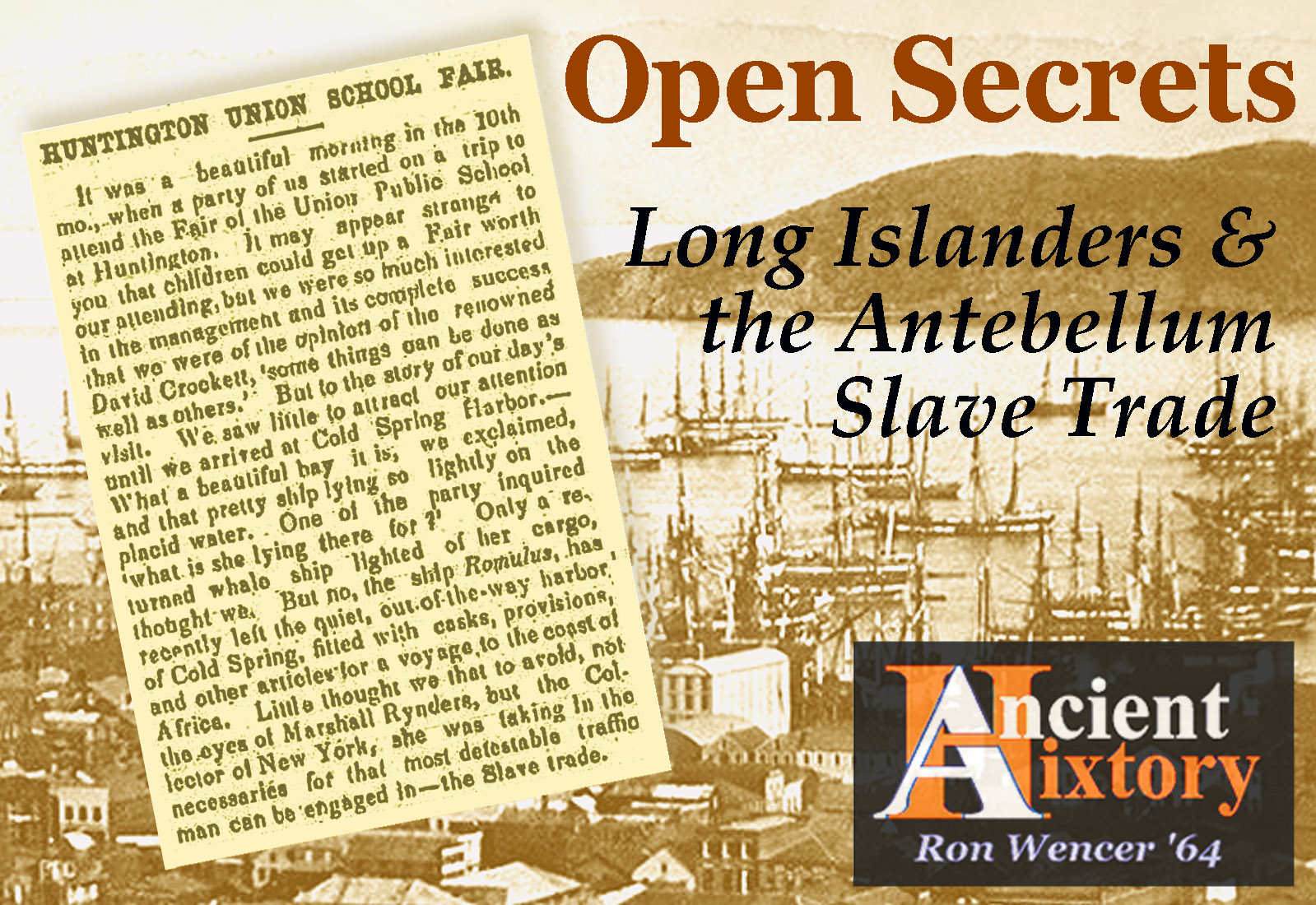
In January 1861, as winter set in, a writer at the Huntington Long-Islander newspaper looked back a few months, to an autumn day when a few friends strolled to a school fair. At Cold Spring Harbor, they were struck by the beauty of the bay, and by a “pretty” sailing ship that lay at anchor. Then the tableau was spoiled; they learned that the old whaler was taking on supplies for the slave trade.
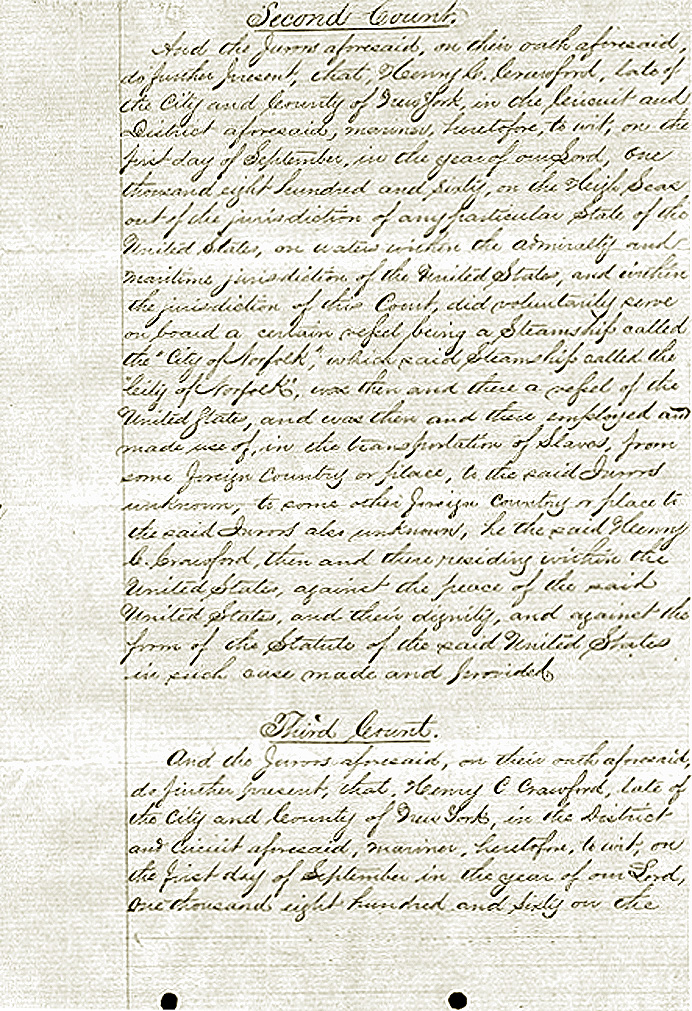 They probably didn’t know that several miles down the road in Hicksville, troubling news was brewing about another ship, the freighter “City of Norfolk.” Some months earlier, it had recruited seamen in Lower Manhattan for a cargo run to Europe, but well into its voyage, the Captain (Henry C. Crawford, reportedly a resident of Hicksville) revealed to them that the ship was a slaver, bound for Africa. The sailors had been coerced into seeing the voyage through, but now they were back in New York, and preparing to testify in Federal court against him. The newspapers would report that Crawford had made “fabulous sums in slave traffic.”
Although slavery itself was still legal in some parts of the nation, trafficking new slaves anywhere in the world was considered piracy by the United States, and it could earn an American a death sentence. Rather than risk a trial, Henry Crawford would plead guilty. Part of his indictment is shown here.
 Rejecting the Slave Trade (or Not)
Slavery had been part of Long Island from the earliest years of European settlement. The Dutch held slave auctions in Nieuw Amsterdam; some of the early Quaker settlers in Jericho kept slaves. After 1800, however, most Europeans and Americans thought the African slave trade inhumane and repugnant, and pressed their respective governments to end it. But even in the North, there were those who favored the continuation of slavery throughout the nation. In 1846, the very patriotic Long Island Farmer printed an article that asked its readers to imagine how their ancestors would have reacted to abolition: “I have no right to my negroes that I bought with my own money? We’ll see about that!” It went on to say that, unlike contemporary freed northern slaves, the old slaves “were no fools, and so stuck to their old masters, whom they had taken for better or for worse….” Evidently, the author had difficulty distinguishing between wives and slaves.
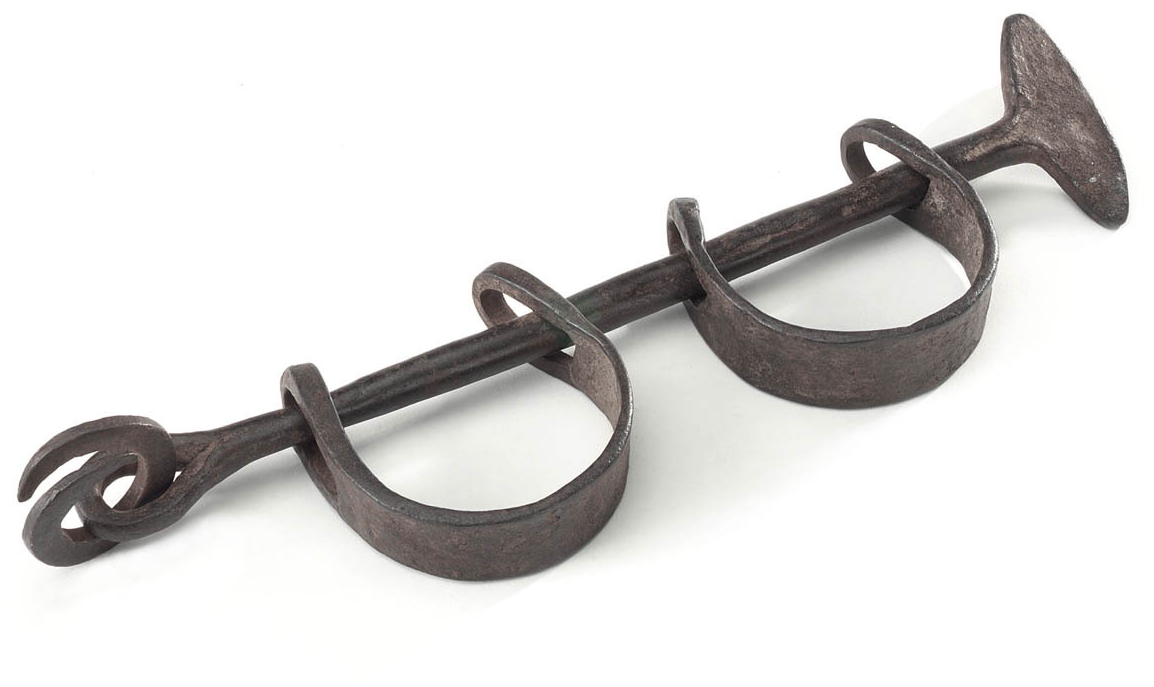
Others involved in the slave trade were less philosophical; they simply chose to profit from it. Harbor masters and sheriff’s deputies accepted bribes to ignore illegal activities. Sailors sailed on slave ships. Shipyards rebuilt whaling ships or freighters into slavers. Blacksmiths made things like leg irons to keep slaves in place on ships.
Whalers
The Island long had been home to whaling fleets. Oyster Bay, Cold Spring Harbor, Sag Harbor (shown above in the frontispiece of this article) and Greenport all had facilities with refitters who were familiar with whalers, and who converted a number of them into slave ships during the 1840s and 1850s.
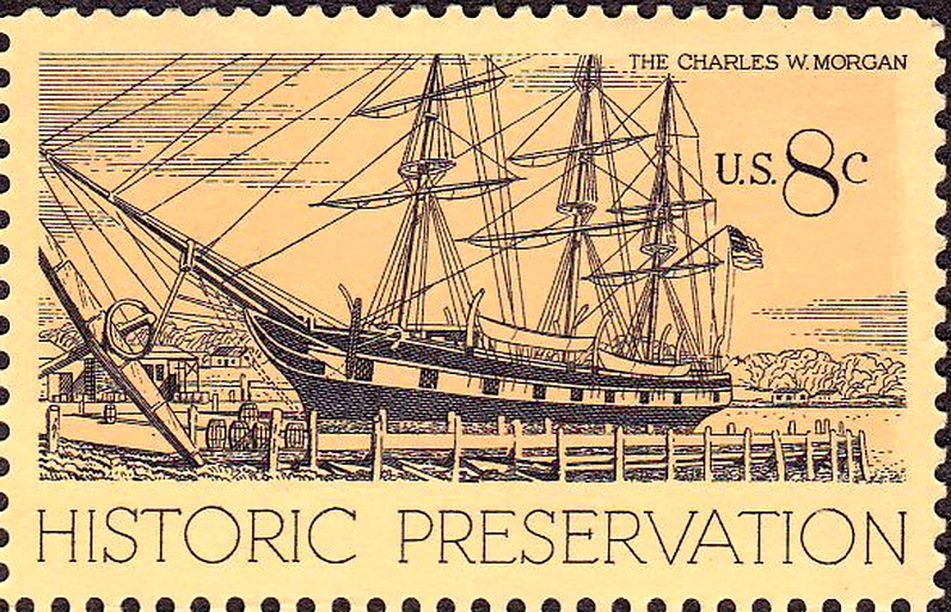 What northeast American whaling ships looked like
Postage stamp of “Charles W. Morgan”
built in New Bedford, Massachusetts, 1841
Old whaling ships were abundant, reasonably priced, and easier to turn into slavers than were many cargo vessels. Built for extremely long voyages, they already were equipped to carry large supplies of fresh water and food. Their cavernous holds could be modified to transport slaves instead of barrels of whale oil. Their decks had “try works” for boiling down whale blubber into oil; these could be turned into primitive kitchens for feeding hundreds of people. Although not swift enough to evade steamship patrols, they might not have to: whales in the ocean near Africa’s slave coast attracted many whaling ships, and a converted whaler might simply blend in.
At least two Sag Harbor whalers were repurposed in the 1840s and 1850s. One was refitted locally; the other was reworked more extensively in Greenport, to substantially increase its slave capacity. Local harbor masters, either corrupt or apathetic, ignored the illegal modifications. In the case of the Greenport conversion, however, someone alerted the Federal Marshall. Before the ship could sail, both its Captain and owner were arrested. The latter escaped from jail and disappeared; he resurfaced as a celebrated Confederate blockade runner during the Civil War.
It may have been easier to convert a whaler into a slaver and send it on its way on Long Island than in New England. The “Romulus” mentioned at the start of this article was originally a Rhode Island whaler, but she was laying in supplies at Cold Spring Harbor. Similarly, the whaler “Brutus” was being converted to a slave ship in its home port of New Bedford, but the work was stopped when the harbor master became suspicious. It left New Bedford, officially on a whaling voyage, but slipped into Cold Spring Harbor to complete the refitting. Evidently, word of the “cooperative” harbor master there had spread. He failed to perform his duty by not recording its arrival or later departure, but he did make a note in his personal diary (discovered many decades later) about the refitting of the “Brutus.”
Better-Organized Crime
By 1850, ocean patrols and harbor surveillance had effectively stopped the smuggling of slaves into French and British territories in the Caribbean as well as the American South. Cuba and Brazil remained vulnerable; their plantations were desperate to pay for new slaves, whatever the price. The risks and profits of slave trading skyrocketed. Independent ship owners and captains gave way to international cartels with deep pockets; lawyers and accountants gained power. With a cartel’s legal responsibilities and financial exposure limited, it could operate multiple voyages a year, hypothetically lose half its ships, crews, and human “cargo“ to storm or seizure, and still make incredible profits.
Disguised as a freighter or a whaler, a ship would set sail from a northeast American port for some announced destination. Several days out, it would change course, and head for the Danish West Indies, to stock its hold with slave trading supplies. It then would sail to the African coast, where innocent villagers captured specifically for this ship’s voyage were already imprisoned in slave pens. Then came the long, terrible voyage west. Despite the slaves being valuable “cargo,” they were treated as expendable sub-humans. Many succumbed to disease, malnutrition, beatings, or the excessive heat in the ship’s hold. Some starved themselves in despair; some tried to rebel and were slain. Sick and dead slaves alike might be chained together and tossed overboard, tied to weights so that their bodies would not float to the surface and betray the presence of a slave ship in the area.
After the survivors were delivered, the ship would be burned to the waterline and sunk in deep water, in hopes of destroying all evidence of the voyage. Crewmen and officers would find other ships on which to work their way home.
Brokers, Secrecy
Voyages were organized by brokers, usually based in northern Atlantic U.S. ports. They communicated in code with specialist cartel agents to acquire ships, refit them, handle international cash flow, find trustworthy Captains and First Mates, etc. Brokers fixed ad hoc problems in port, bribing harbor masters, explaining away modifications to a ship that suggested it was a slaver. Experience taught brokers which officials had to be circumvented by postponing some refitting and resupplying until after a ship left port. When this happened for a Manhattan departure, a cozy Long Island harbor was the obvious next stop.
Captain Crawford’s Voyage
The “City of Norfolk” was one three voyages brokered in 1860 by Albert Horn on behalf of the Portuguese Mora Cartel (named after its two bosses, brothers who respectively operated in Europe and the U.S.). It had agents in Africa, Europe, the Caribbean, Brazil, Cuba, and American cities. They communicated via coded messages, embedded in postal mail that crossed the oceans on ship, telegrams that crossed nations by wire, and written messages concealed in wealthy travelers’ luggage, garments, and personal items. To combat the cartel, American and British agents broke codes, steamed open and re-sealed intercepted letters, created disinformation, and even inserted double agents into the cartel.
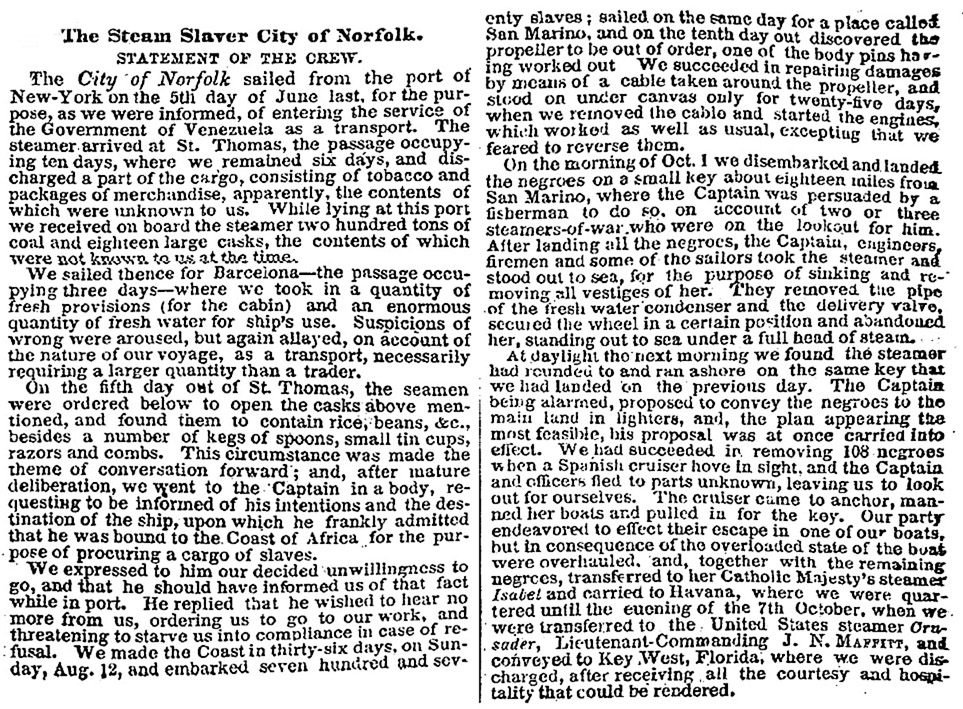
As the “City of Norfolk” neared its final delivery spot in Cuba, Spanish patrols were on watch, and it could not outrun them. The Spanish took everyone to Havana to sort things out. The Africans who remained on board were not sold into slavery. The ship’s officers and crew were taken to Key West. Those crewmen who had been hoodwinked into serving on a slaver drafted a statement that would help substantiate the later indictments against Horn and Crawford. It was printed in the New York Times of October 26, 1860:
Wrap-Up
I have been thwarted in my efforts to learn more about Henry C. Crawford, but I am not surprised. He could not have been born in Hicksville, because to serve as a First Mate or Captain in 1860, he must have been born before people of European ancestry permanently lived there. As an adult, he likely was at sea most of the time, and thus missed being recorded in censuses and local directories. If he did live in Hicksville, he may have kept a room in the Grand Central Hotel, and used it only between voyages. I have not yet found any record of where he was incarcerated.
Albert Horn was pardoned a few years later by Abraham Lincoln, because he was dying from acute lung disease. Given the thousands of people whose lifetime slavery he arranged, I question Lincoln’s showing him mercy.
As a child, when I learned about the Civil War, I felt irrationally smug about being a Northerner. The North was “where the good guys came from.” I clung to that thought for a long time, but I eventually realized that life is more complicated than it seemed in my childhood. Having now looked into the grim world in which Henry Crawford and men like him lived, I am less sure about things, but I can say this: The North was not all good guys.
Sources
- John Harris, The Last Slave Ships: New York and the End of the Middle Passage
- Letter from Albert Horn Refuting Allegations of Slave Trading, New York Tribune, June 1, 1860
- The Steam Slaver City of Norfolk, New York Times, October 25, 1860
- Important Arrest of Alleged Slave Traders, Brooklyn Eagle, May 3, 1861
- Huntington School Fair, Huntington Long-Islander, January 11, 1861
- Various criminal records related to Albert Horn and/or Henry Crawford, National Archives and Records Administration, online at catalogarchives.gov
- Voyage of The City of Norfolk, slavevoyages.org
- Ouidah in the slave trade, Wikipedia
- Illustration of Leg Irons, understandingslavery.com
- U.S. Postage Stamp that depicts Whaling Boat, Wikimedia Commons
- Photograph of Sag Harbor in the 19th century,
- https://hamptonsboatrental.com/hamptons-things-to-do-blog/sag-harbor-highlights
- Kevin S. Reilly, Slavers in Disguise: American Whaling and the African Slave trade, 1845-1862, The American Neptune, Peabody Museum
- The Whaling Ship That Sank as a Slaver, timqueeney.com