
 When the HixNews team met this month, and the weather was cold, we reminisced about the cold, snowy, and icy weather conditionswe remembered in Hicksville. That's why we are reprinting Ron Wencer's article, 20,000 Seconds Over Hicksville. Besides that, there is a brand-new Ancient Hixtory article from Ron and one from Wendy Elkis Girnis. We would love to add some writers to our team! Please email us at
View The Hix News Team
Contributing Writers:
This email address is being protected from spambots. You need JavaScript enabled to view it. - '64, Where are They NowThis email address is being protected from spambots. You need JavaScript enabled to view it. - '77, My Memories- Karl Schweitzer - '81, The Hicksville Connection
- Thomas Connolly - '74, Financial Conversations
- Joseph Platt - '64
- John Maniec - '64
Editors:
This email address is being protected from spambots. You need JavaScript enabled to view it. - '77This email address is being protected from spambots. You need JavaScript enabled to view it. - 77
Webmasters:
This email address is being protected from spambots. You need JavaScript enabled to view it. (spouse of Eileen Goldstein - '77)
Web Development and IT:
This email address is being protected from spambots. You need JavaScript enabled to view it. - '08
Editors Emeritus:
- David J. Rubin - '82
- Elliot Gorlin - '63
- Valerie Pakaluk - '51
- Henry Lichtenstein - '59
- Marc Malamud - '77
Founding Editors:
- Pat (Koziuk) Driscoll - '56
- Linda (Piccerelli) Hayden - '60
- Buffalo Bob Casale - '61
Founding Webmaster:
- Roger Whitaker
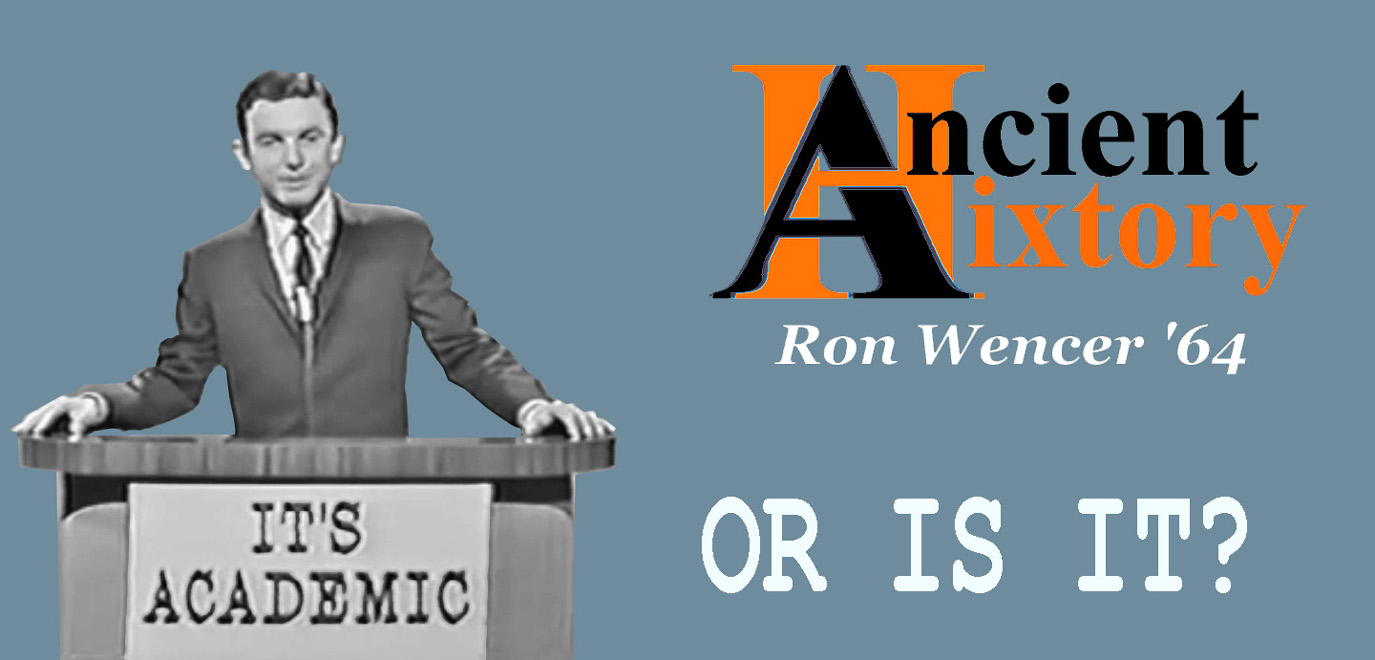 Introduction
On a school day early in September 1963, about two dozen Hicksville High seniors were summoned to a meeting. We were seated in a semi-circle of student desks, all facing a pair of chairs, in which sat two adults whom we did not know. More than a half century later, my memory is imperfect, but I believe that also present in the room, standing, were Principal Leon Galloway, Vice-Principal Raymond Rusch, a smattering of faculty members, and a few other strangers. I think that Mr. Galloway opened the meeting.
He explained that WNBC TV was about to launch a program in which high schools in Greater New York would compete against each other, represented by panels of students. The meeting had been called to select the students who would represent Hicksville High. The visitors seated in front of us were from the production company of the show, which was called “It’s Academic.”
For the next 90 minutes or so, they peppered us with questions about history, science, literature, the arts, politics, etc. Most questions focused on only one of those subjects, but some involved knowledge of more than one. We were to raise our hands as soon as we were confident of our answer, but to give an answer only if asked. When the questions stopped, we were thanked and politely dismissed.
 The Team
Later that week, the selected pupils were notified. Hicksville would field a strong team, with a first-string panel of Stephen O’Brien, Barry Cressman, and Mel Bienenfeld; Steve was designated Team Captain. Two alternate panelists (to be used only in case of dire emergency) were also designated: “Chic” (Charles) Hassell and myself. The panel is shown here in a photo of a home TV screen which appeared in the 1964 Comet Yearbook.
I had sat in classes with Barry and Steve since Junior High, and I knew their respective abilities. Both were strong in terms of literature, writing, history, and culture. Steve was especially strong in French and Latin, was learning German, and dabbled a little in Hungarian. I did not meet Mel until High School, but I quickly learned that he was a proficient musician as well an exceptional math student. Mel earned the highest score ever attained by a Hicksville student in the annual competition of the Mathematical Association of America. I was confident that the Hicksville High panel would do well.
 The Show
We went to the NBC Studios at Rockefeller Center to tape the show on Saturday, September 21, 1963. The host was Art James, who is shown in action at the beginning of this article. The show was broadcast the following evening, airing opposite “Mr. Ed,” a CBS series that featured a talking horse.
Hicksville’s opponents were Baldwin High and Mamaroneck High. As I recall, the competition was close in the beginning, and the lead changed several times. Later, Baldwin pulled ahead to stay. As a reward, Baldwin would advance to a playoff show, on which it would face two other first-round winners: South Side High (in Rockville Centre) and Regis High, a well-known Catholic school.
Post-Mortem
Although the show was brand-new to us, local versions of “It’s Academic” had been aired for several years by network affiliates in Baltimore and a few other cities. This was only the second show of the Greater NY version. The first NY show did not air until after our team was selected, and I don’t know of anyone in Hicksville who saw it. I wondered afterwards how well the selection criteria for the panels (we never knew what the criteria were) matched what was needed for the show. When you actually saw the show, you heard in its introduction that “teams from three high schools in the metropolitan area compete against each other both in the field of general knowledge and academic subjects.” That is, to have a good shot of winning on “It’s Academic” you had to know some unspecified stuff that definitely was NOT academic.
Doubtless, including non-academic questions in the show made sense for the show’s producers. The top contestants from all schools would have extremely similar academic backgrounds, and they probably would answer all the academic questions equally well. In a purely academic scenario, it was unlikely that any team would get too far behind to catch up: pupils who were not the strongest academically had been weeded out in the selection process.
Viewers, however, liked the excitement of dramatic come-from-behind victories, and that was why General Knowledge questions were shoehorned in. They destabilized the competition because they were hit-or-miss. You didn’t study for a Regents exam in General Knowledge; you acquired snippets of it by chance. Because of that inherent randomness, one might argue that General Knowledge questions were fair; on the other hand, panelists had been selected according to classroom learning.
General Knowledge often proved to be an Achilles Heel, and it was for Hicksville. As Chic Hassell and I sat together in the section reserved for Alternates, Hicksville was asked, “In the U.S. Army, what rank’s insignia features an oak leaf?” We both knew the answer, but he whispered to me, “These guys won’t know this,” and he was right. Dumbfounded, the panel could not even make a guess, and another team snapped up the discarded points. Hicksville never overcame that setback.
 Incidentally, here is a 1960s insignia pin for a U.S. Army Major. I think it was designed with an excess of artistic license.
It was not much comfort to see the same thing happen to other teams. In the playoff show for the first-round victors, South Side looked strong early, but when asked to identify “a Polish hero of the American Revolution, after whom a highway has been named” it incorrectly responded “Tadeusz Kosciuszko.” Baldwin surged ahead by countering with “Casimir Pulaski,” but later it met doom on its own. When asked to identify “a 1920s dance craze that was named after a famous aviator” the Baldwin panel just sat in stunned disbelief. The game was nearly over, and they rushed through their remaining questions (i.e., the faster you answered, the more questions you got, and you might recoup lost points that way). In their haste, they made mistakes and sank into second place, miserable. South Side won after all.
Did winning or losing the show prove anything? Could anybody seriously think that one school was better than another because one teenager happened to have heard about a brief fad from two decades ago? If you’re curious, that dance was the Lindy Hop, an extremely athletic, throw-your-partner dance that eventually gave way to the different (and much tamer) Lindy. The latter was popular at HHS dances well into the 1950s.
Post Script
I kept in touch with Steve, but not with Barry or Mel. As I was writing this article, I wondered about them, and I did some online research, the fruits of which are included below. I have not attempted to contact either of them.
 Before
 AfterSteve
Here are “Before” and “After” pictures; the latter was taken a dozen or so years after the yearbook photo. In the interim, he not only grew hair; he also started boxing and lifting weights. Really.
He had intended to teach Latin, but that idea was abandoned (i.e., once the Roman Catholic church stopped saying Mass in Latin, the global number of Latin students dwindled to practically zero). Armed with a degree in Latin and Classical Greek, he instead embarked on a career of New York City administrative jobs.
Steve focused more on things that did not relate to his employment. He spent evenings and weekends improving his French, learning Russian and Spanish, and studying the literatures of those languages. He eventually earned a Masters, and then a Doctorate, in Comparative Literature. En route, Steve took many leaves-of-absence from his job, traveling to Paris or Moscow to study. He completed a Translator Program at the UN. To broaden his grasp of the languages he’d learned, he worked on contract at the Manhattan offices of an international bank. After retiring from NYC, he became a civilian instructor for college-level literature courses on U.S. Navy warships. Once his background became known to those onboard, Steve repeatedly was called upon to translate into Latin phrases that Naval personnel wanted to add to their tattoos!
Late in 2013, he was diagnosed with cancer, and began a regimen of chemotherapy, which seemed to progress well. Before it was completed, however, he suffered a fatal stroke, unrelated to his cancer. Thanks to his family, I had the honor of eulogizing my long-time friend at his Funeral Mass.

 Barry
Barry
Per our yearbook, Barry intended to become a lawyer, but things evidently changed. Instead, he had a long career as a Pastor (the Presbyterian equivalent of what many other denominations call a “Minister”).
Following college, Barry attended a theological seminary, then went on to further theological studies, which included time at St. Andrew’s University in Scotland, where he earned a Masters. He eventually became Pastor at a church in Titusville, Pennsylvania. There, he earned the respect of the Church members and, through his local community service, the respect of many other residents of Titusville and Crawford County. Now retired from his pastorate, he serves as President of the Crawford Heritage Community Foundation, a non-profit that manages over 150 charitable funds in northwest Pennsylvania. Barry’s “After” photo is fairly recent, and can be found on the website of the foundation that he heads.
Barry, if you’re out there, I’ll take a good-natured poke at you now, for allowing the Titusville newspapers to report that you hail, not from Hicksville, but from Oyster Bay!

 Mel (2018)Mel
Unlike Steve and Barry, Mel went on to do what the yearbook said he wanted to do: teach mathematics. He earned both a Masters and a Doctorate from Cornell, and has taught at a number of colleges. But like his fellow one-time panelists, he found that life entails many things beyond job descriptions.
I don’t believe that I ever discussed politics or philosophy with Mel when I knew him, but online I’ve seen that he is an ardent, sincere, and outspoken socialist. For years, he has written blogs and articles that target injustices, seek to make society more fair, and promote changes that would make the lives of disadvantaged people more sustainable. It thus is not a surprise to see that he has been president of a union, and has negotiated faculty contracts with colleges. Indeed, his “After” picture is taken from the website of the Westchester Community College Federation of Teachers; it was included in a posting that discussed 2018’s contract negotiations.
I don’t know enough about Mel at this point him to say more, other than that he seems to have worked tirelessly, has not shied away from protest, and appears to have lived according to the principles he espouses.
That’s It!
 Wendy Elkis Class of 1977
As we approach the 250th anniversary of the United States’ independence from Great Britain, we thought it would be fitting to introduce articles that showcase the struggles our New York forefathers went through to win that independence and break ties with Great Britain, its Parliament, as well as with King George III.
In The Beginning
New York was originally inhabited by Indigenous people, the Lenape, until 1624. The Dutch West India Company settled the area we know today as Manhattan and  Manhattan Island in the 1500snamed it New Amsterdam. The Dutch were involved in the fur trade. Under Peter Stuyvesant, New Amsterdam was known for its
 Peter Stuyvesant religious tolerance, diversity, and growth. In 1626, the Dutch, under Peter Minuit, took control of Manhattan from the indigenous peoples for what some history books claim was $24. At the time, the indigenous people did not have a concept of commerce, so they were not aware that they were “giving” their land to the Dutch. They thought that the Dutch were thanking them for the use of the land. Unfortunately, the Lenape never set foot on their summer hunting grounds again. By 1664, New Amsterdam became New York, renamed for James, Duke of York, when the English acquired the land.
 Dutch surrender
The Ramifications of a War
Jumping ahead, after the French and Indian War (1754-1763), the Colonies were taxed by Parliament to pay for that war. One of those taxes, the Stamp Act in 1765, required an official government stamp on newspapers, playing cards, almanacs, and commercial papers. When the stamps arrived in New York that year, and were sent to Fort Fort George Uprising George, 2,000 protesters showed up. By October 31st, the Sons of Liberty sent another 2,000 men. The protest ended with the carriage and sleighs of the lieutenant governor set on fire, and the home of the fort's commander ransacked, and his possessions burned.
Part of those 1765 “taxes” was the Quartering Act. This act required British soldiers to be quartered in barracks and public houses at  The Quartering Actthe expense of the colonies. If none were available, then they would be housed in inns, houses, barns, and other buildings. This act was disputed on the grounds of violating the English Bill of Rights of 1689, which said, "raising or keeping a standing army in peacetime, without the consent of Parliament, is against the law." Our third amendment stems from this law and is the only amendment that has never been challenged in the Supreme Court. Between the taxes the colonists were required to pay and the Quartering Act, the phrase "No Taxation without Representation" came to be.
Trying to Fight Back
In 1766, when 1,500 British troops arrived in New York, the New York Assembly refused to quarter them. This caused the troops to remain on British ships. Parliament then passed the New York Restraining Act of 1767. Due to this act, the New York Assembly was suspended in 1767 and 1769 for not allocating funds to house the soldiers. The governor of New York was also suspended. Another consequence was the conflict in Golden Hill Rebellion 1770, between British Soldiers and colonists known as the Battle of Golden Hill. By 1771, the New York Assembly allocated the necessary funding to house British troops.
Check out Part 2 next month: New York's response to the Boston Tea Party.
Resources:
Quartering Act - https://www.history.com/this-day-in-history/may-15/parliament-passes-the-quartering-act
https://www.bostonteapartyship.com/the-quartering-act
New York History - https://en.wikipedia.org/wiki/History_of_New_York_City_(1665%E2%80%931783)
https://www.history.com/this-day-in-history/september-8/new-amsterdam-becomes-new-york
Revolution Timeline - https://www.battlefields.org/learn/articles/american-revolution-timeline
https://share.google/aimode/RYOgFgCxw9cJSolq0
Images
Lenape in Manhattan - https://share.google/LZEUmh5QU8PrvoPWV
Peter Stuyvesant - https://share.google/kYNotXi7rBi6CnwxJ
Peter Minuet - https://share.google/NfWyR7785E2nAwT8G
Dutch Surrender - https://share.google/mwj4o2nxn620ubtnt
Fort George Rebellion - https://share.google/N8GfqTsK0yN7I4boJ
Quartering Act - https://share.google/d5zSArnOxWIqN8GKG
Golden Hill Battle - https://share.google/BNE9JmjVCV2acstgJ

It was the 1970s, but it might as well have been the 19th century. A winter storm was hitting Long Island, and in the morning the LIRR sent train after train of passengers westward - even though the line was impassable. Thousands of commuters found themselves marooned above Hicksville, east of the frozen switch points at DIVIDE tower.
In the old coaches used on some of the trains, frost formed on windows. A frigid wind blasted up through the so-called "toilets" - open holes with seats above them, through which one could see the snow on the track below. The chill found its way through the many cracks into the main passenger space. After a while, the heating and the lights failed. Many of the shivering commuters had no seats; they stood for hours in the aisle, holding onto the seats' backs to steady themselves. I was one of them.

An optimistic account of the day's events - if
you had to change trains, the second train's
delay compounded your first train's delay
New York Times, February 3, 1976
***
The Good Old Days
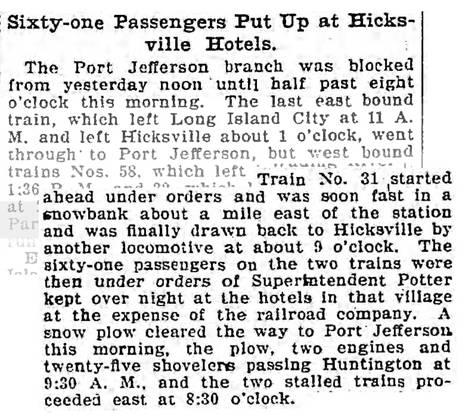
Nearly a century earlier, Hicksville had acquired a paradoxical reputation among winter travelers in the New York area. It famously welcomed passengers (including one Mayor of New York) who had been rescued from snowbound trains. That was because if a train was going to get snowed in, there was a very good chance it would get stuck close to - but not actually in - Hicksville.
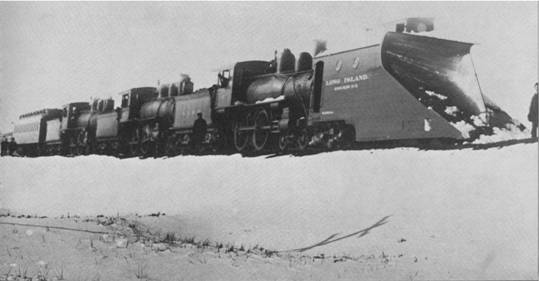
The storms of the era would carry snow across the Long Island plains that lie to the southwest, and then see fit to finally drop it some miles east of the village. Snow drifts would stop, and perhaps even bury, a train. A member of the train crew then had to head out into the storm on foot and seek help, often at Hicksville, because the hotels there could house winter passengers on short notice. Once alerted, hotels, merchants, and private citizens would send out men in sleighs to rescue the passengers. They brought rugs to cover shivering laps, and strong drink to warm chilly hearts. The sleighs would ride back over the snow, and the passengers finally would be welcomed (at the railroad's expense) with warmth, food, and overnight lodgings. Meanwhile, the railroad sent out crews to clear the tracks.
Brooklyn
Daily Eagle, 1902
Photograph by H.B. Fullerton, Collection of St. James General Store
as printed in Steel Rails To The Sunrise
By the 1970s, "big snow" winters were rare, Hicksville's "hunting lodge" hotels were gone, and "snow trains" with steam locomotives that pushed mammoth plows existed only in old movies. The notion of passengers' being marooned out-of-reach somewhere near Hicksville seemed ludicrous.
*
Bethpage 5:00 AM
Between 1975 and 1981, I commuted by rail between Bethpage and the Wall Street area. On that morning, because an overnight ice storm had been predicted, I arose earlier than usual, to allow myself extra time to get to work. I went outside with Jack, our Airedale, and we discovered that the air was cold, snow and ice were falling, the winds were very strong, and everything was heavily coated with ice. Jack, who understood why he had to be outside on such a horrid morning, was no fool; he cooperated quickly, and we turned back home.
Although I considered staying home because of the weather, it was obvious that the trains were running regularly. I could see and hear them: we lived at the head of a T-shaped intersection, and from my living room window I could look down the T to the street-level crossing at the Bethpage station. I got dressed for work (suit, tie, gloves, businessman's light overcoat). By 7:00 AM I was slipping and sliding (albeit not as suavely as Little Richard would have) down to Stewart Avenue.
The train would be crowded; bad road conditions would divert automobile commuters to the railroad. As always, it arrived fashionably late (about five minutes behind schedule). Despite the crowding, there were a few seats free, and I happened to get one. The diesel's horn tooted twice, and we began to move. I settled in, and let the train rock me back and forth. I gazed though the smeared windows, watching the snow swirl as we accelerated past Grumman. It was not a bad start for what had looked like a daunting day; things were unfolding as they should.
That particular train was not due to stop until we reached Jamaica, so in a little while, in the 30 or so seconds from the time we crossed over Old Country Road until we had passed the station, I would get a glimpse of ice-coated Hicksville.
*
Just past New South Road, however, the train began to slow, more and more, until it was scarcely moving. I was sitting on left side of the train. Though I was adjacent to the aisle, and the snow was falling heavily, I still could see well enough through the window to make out the old LILCO complex ahead. The train very slowly followed the track up the embankment, its wheels groaning, and we stopped. Because we had entered the start of a curve, we were tilted at an angle, and it took effort not to lean against the person sitting on one's left. The people standing in the aisle were having a worse time, leaning despite themselves against those who sat nearby. Time passed; we stayed like that.
This was an "old train" (see Two Worlds, below, for an explanation). There were no PA speakers, which at least saved us the task of trying to decipher garbled announcements. The car was silent, save for the words "Oh, excuse me," which were uttered repeatedly, whenever people standing on the tilted floor shifted position, and accidentally leaned into (or stepped on the toes of) someone else. Although I had been seated, as the delay persisted, I surrendered my seat to a young woman who was standing nearby. Her stylish spike-heeled boots (Ideal footwear for an ice storm, no?) were clearly unmanageable on the slanted floor.
*
Hicksville (somewhere on the 2nd Floor), about 8:25 AM
The door at the front end of the coach was yanked open, and in came a snow-covered acquaintance of mine, also named Ron. I knew that his customary morning train would have departed Bethpage at about 6:40 AM; he should not have been on this train. Before he continued down to the other end of the car, he paused, and we talked briefly. This is the gist of what he said:
Overnight, ice had fallen so rapidly that the melting devices fitted to the elevated tracks at DIVIDE tower could not keep the track switches clear. The spot where the Port Jefferson and Ronkonkoma lines converged had become impassably solid with ice. In the early morning, optimistic that the ice blockage would be broken quickly by track workers, the LIRR had sent all the normal trains for those two lines towards the impasse. Now, hours later, the switch points were still frozen solid.
Ron had left Bethpage early, more than an hour ahead of me. After being stuck so long, he had lost patience - so he walked to the end of the car in which he had been riding, went out to the vestibule, opened the steps, and climbed down to track level to look around. There, he saw a line of perhaps six trains, end-to-end, extending back towards Bethpage. He also looked across toward the Port Jefferson branch, where he saw trains similarly backed up.
By talking to the train crews (who seemed not to mind that a passenger was walking around up on the elevated tracks), he learned that the first train in this impromptu "conga line" had run out of fuel for heating (again, see Two Worlds, below, for an explanation), so that train had been connected to the train behind it, which soon followed suit. Now, neither of the two trains had any heat.
And so, Ron was squeezing his way along the length of train after train (and thereby getting glared at a lot). Between trains, he would climb down to track level, and walk in the storm until he could climb up onto the next. When he got past the last train in the line, the track would be back down on ground level, and he would find a way to walk home.
Note: This was 1976, so:
There was no Internet; there were no cell phones. There was no way to find out what lay ahead, or to call your workplace, or to call home.
The track to Bethpage was not yet electrified. Ron ran no risk of being electrocuted.
For a long while, nothing much happened. The snow and ice got noticeably lighter than before, and the gusts probably no longer topped 30 mph, but the old coach in which I stood was rife with icy drafts. Cold air even blew up from the floor wherever the passenger seats were attached to it.
The train suddenly lurched forward, coasted a while, and stopped again. A few people gave half-hearted cheers of sarcasm. A train ahead of us must have made it through to Hicksville! I was encouraged to think that we might soon get our turn. We were closer now; I could see part of Marie Street, including the side of the Fire House. Amazingly, I also saw a long ladder that angled up to the overhead track structure. Evidently, Hicksville FD had positioned an aerial truck (I could not see the truck itself because of buildings were in the way) and deployed its ladder.
Seeing the ladder, people began to talk. A few thought that we all - the thousands of us who were stuck up there - would be evacuated down the ladder. Some optimist thought that the Red Cross was going to give us hot coffee and doughnuts, by having firemen carry them up the ladder for us (Sorry, I wanted a coffee with TWO sugars - would you mind going down again and getting me one?). I assumed that the ladder was strictly an emergency provision, in-place should a stressed passenger suffer, say, a stroke or heart attack. Given how isolated we were, I was grateful that someone was thinking about us at all.
*
Hicksville Station Platform, about 10:15 AM
A second lurch forward brought us into Hicksville. Eager to escape, or just to stand on level ground - well, level concrete - for a change, many people rushed out of the train. It headed off to Queens. I decided to go home instead of work.
Except that, given the icy roads and the icy everything else, I didn't want to wait on line at a phone booth, and then arrange for somebody to risk driving me back home. The best thing would be to simply take the next train back to Bethpage, and walk the one block back to my house. I asked when the next train east to Bethpage was due.
"Next train heading east? There are none. All the trains we have are either stuck out there, waiting to head back to Jamaica, or they're on their way as we speak, so that they can get new crews and be refueled before they get put back into service. There won't be any eastbound trains for a few hours."
And so, I instead waited for the next train heading west, to the City. It took a while, but when it arrived it was warm (it had come from Huntington, where the line was electrified; the cars were the then-new new silver and blue M-1s). Everybody crowded in. It departed at around 11:00 AM, and it made lots of stops. Even when it didn't, the train in front of us did, so we stopped between all the stations we had passed. It was a slow journey to Jamaica.
The "change at Jamaica" madness was more chaotic than usual, but I quickly found a connecting train to Atlantic Avenue (Brooklyn), from which I would take the subway into Manhattan. Again, the tracks ahead of us were congested; the trip to Brooklyn was extremely slow.
*
Chase Manhattan Headquarters, 1:03 PM to 2:35 PM (including my 42 minute workday)
In comparison, the subway moved like a skyrocket. I arrived at my desk just after 1:00 PM, and I gave my boss a quick summary of my morning's travels. He laughed (The nerve of some people!) and told me to turn around, go back home, and rest. I then called my wife, in case she was worried. "I'm at work," I announced, for some reason expecting to hear a sigh of great relief. Oblivious to what I'd been going though, she simply answered, "So?"
To kill a little time (and the let the LIRR get ready), I had lunch at Chase. I did a small amount of work, and then I set out on my return Odyssey. I subwayed to the LIRR, and I did not have long to wait for a train to Hicksville, one which was scheduled to connect with a train to Bethpage.
*
Hicksville Station Platform, about 5:15 PM, (7 hours after my morning arrival)
The train was not crowded, and the trip went smoothly. To my shock, my Bethpage connection was waiting. I'd be home in Bethpage in less than 15 minutes!
Or not.
The train sat there, nearly empty. As expected, the equipment was decrepit (yet again, see Two Worlds, below), but this time the heat and lights worked, which made a big difference. I settled in by a window and a warm radiator, and I watched my old hometown appear to do absolutely nothing for a while.
The silent waiting dragged on. On the platform, the train crew appeared to run out of things to discuss. A Huntington-bound silver train stopped on the other track, discharged some passengers, and went on its way. Some time later, another train did the same thing. After I'd sat there for over an hour, a diesel train arrived on the other track, and it stayed there. A Trainman came into our car and told us that we should get on the newly arrived train.
Ever-obedient little lemmings, we did as we were told. Again, nothing happened for quite some time. Finally the same Trainman, remarkably unembarrassed, came in, and he told us to return to the first train, as plans had changed (Plans? The possibility that there were plans had not occurred to me). All of us went back to the first train, and we began to re-warm our old favorite seats. Now empty again, the second diesel train headed west, towards Jamaica.
Eventually, another "Silver Snail" slid into Hicksville. It disgorged a lot of desperate-looking passengers, who ran frantically to our train, as if their hurrying mattered. We waited further, and then we abruptly stopped waiting - with no announcement, the train departed. I got off at Bethpage, walked the one icy block to my home, and got in the door just after 8:00 PM.
***
The Numbers
To recap, my morning commute had taken around 6 hours. My evening commute had taken only a little less. In between, I had worked fewer than 45 minutes at my job. In total, I had spent more than 5½ hours stuck over Hicksville.
Much of that time was spent under truly deplorable conditions, confined on elevated track in a very drafty old railroad coach with no heat, water, or acceptable rest room. Why were things on the LIRR so bad?
Let's find out.
***
Two Worlds
As its LIRR tower proclaims, Hicksville is the point at which the central line of the railroad divides in two. "Port Jefferson" and "Ronkonkoma" trains (to use the common, if unofficial, names for their respective branches) are on separate tracks east of DIVIDE tower, but they share the Main Line west of it.
Divide Tower before grade crossing elimination
http://www.lirrhistory.com/dec2003/divide.JPG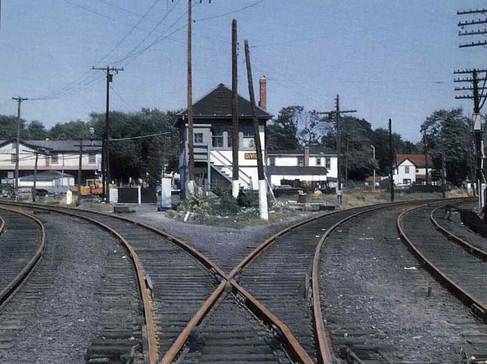
The tale of the storm highlights the "Have / Have Not" differences which existed in the 1970s between these branches. In those years, if you lived in, say, Huntington, you were blessed with electrification and the new trains that came with it. The fact that the M1 equipment would develop some very real operational problems does not diminish the fact that, in general, electrification had substantially improved the quality of passenger service on the line. If you were stuck in an M1 car during the Ground Hog Day storm of 1976, you still had heat, air circulated by a modern ventilation system, working restrooms, and if you were seated, a comfortable seat.
It is understandable that financial resources were not available for the railroad to improve and electrify Ronkonkoma service at the same time as Port Jefferson service. What is not understandable, however, is that the quality of commuter service on the Ronkonkoma branch had been permitted to substantially deteriorate in the years leading up to that time, and that adequate steps were not taken to maintain minimum service standards, even when things became dire.
*
In the early 1970s, it was still true that much of the diesel passenger car fleet had begun its service as part of the steam passenger fleet. A small part of it had been built in the 1960s; and a large part of it dated from the 1950s. Many of these cars had to some degree been upgraded (e.g., acrylic windows been replaced the original safety glass, to better resist vandalism). The remainder of the fleet - and until 1974, this remainder was a significant minority of it - dated from the 1930s and the late 1920s. These cars had gone through rebuilding programs some years before, but the oldest among them remained primitive, especially in terms of restroom facilities.
Things came to a head (no pun intended) in 1974, when part of a 1920s coach suffered a structural failure, causing a minor crash. Damage was not serious, but the implications were - all of the remaining 1920s coaches had to be withdrawn from service immediately and scrapped.
The railroad had to scramble, desperately trying to pick up surplus commuter coaches from other railroads, but good coaches were not easy to come by. If it found a car that had seats, would not suffer structural failure, would roll safely on the track, and had operating brakes, it was worth acquiring, and it was put into service as soon as possible. Note that compatibility with LIRR electrical standards for power to be used for lighting, fans, and heating were not mandatory. Thus, on dark winter evenings in 1976, I often rode home in a coach that had neither lights nor heat. For a while, the regular Trainman wore a miner's helmet, with a light that let him see the tickets he was punching (he later switched to carrying a flashlight).
*
The above explains why some cars never had heat. But why, during the ice storm, would an entire train of coaches lose power all at once?
Railroads use different methods to generate "hotel power" (i.e., electricity appropriate for lighting, heat, and air conditioning) for passengers cars. In the 1970s, most commuter railroads in North America, including the LIRR, took the same approach, which was easily recognizable. From the outside, their commuter trains appeared to have two unmatched diesel locomotives, one at each end.
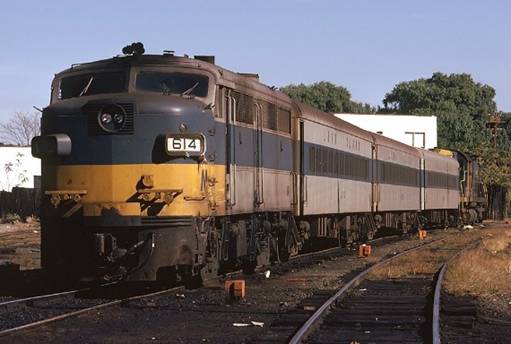
LIRR Power Car 614, purchased as a used Alco FA-2 locomotive
from the Burlington Northern Railroad; the newer diesel engine at
the other end of the train actually pushes or pulls it.
https://www.pinterest.ca/pin/659707045388146893/
© George W. Hamlin
In reality, one of the apparent locomotives no longer functioned as one. Typically, it was very old, and it had been acquired second- or third-hand after decades of service. It then was rebuilt into something called a "Power Car." An engineer could drive a train from a Power Car, because its controls were connected electronically to the real locomotive at the train's other end. The Power Car's other purpose was to generate hotel power for the train. The old combustion engine inside it was no longer connected to its wheels, so it could not move the train (or even the Power Car itself); it simply generated electricity.
So, what went wrong on February 2? The trains for the morning rush hour had spent the night out east. Their Power Cars had only enough fuel in their tanks to handle their morning rush-hour assignments; after that, they would be refueled in Queens. But when a 90-minute run from, say, Ronkonkoma to Hunterspoint turned into a 5-hour run, they ran out of fuel. The real locomotives had plenty of fuel to move the trains - but they did not have the generators needed to create hotel power. Poof! No more heating and lights.
*
So, many, many commuters suffered on the day of the ice storm, but some of those who lived on the diesel branches suffered more.
Although I normally feel an attachment for the place in which I grew up, I do not have many fond memories about having to hover over Hicksville for all those cold hours.
***
And to close....
Imagine being able to tell all your family and friends that you had got your name in the newspaper!
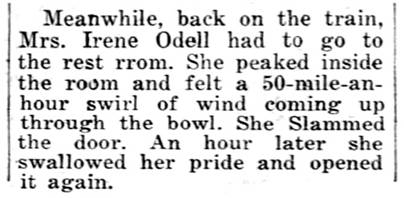
New York Daily News, February 3, 1976
*****
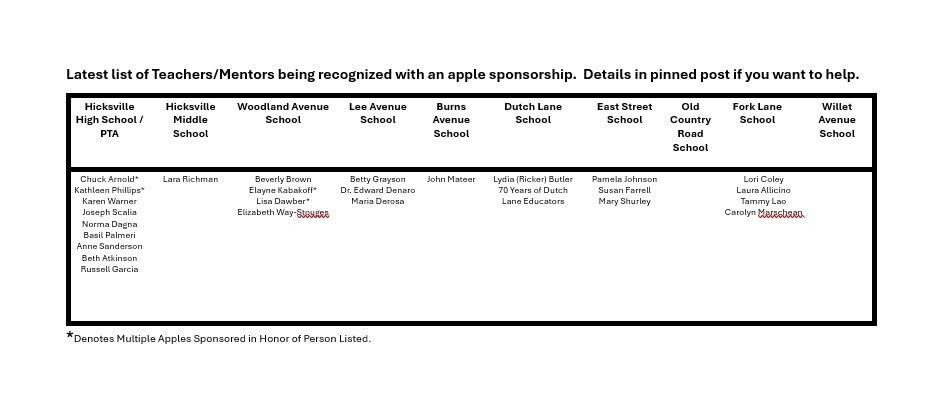
The 2026 Scholar Apple Sponsorship has officially closed, and the Hicksville community showed up in a big way! According to Ted Urban, in the Hicksville High School Alumni Foundation, Inc. Facebook page, "Together, we covered 75 of the 91 apples - an amazing tribute to the educators and mentors who shape our district." The top 20% of the graduating class will receive an apple at the Scholars Dinner. The Hicksville Council of PTAs wrote on Facebook, "Your generosity helps recognize and celebrate our scholars in a meaningful way. Thank you for always showing up for our students and for making our community so special."
In Memoriam
Elayne Kabakoff, Woodland Avenue teacher, passed January 13, 2026
Harry J. Single was President of the Hicksville Community Council, VP of the Midland Civic Association, board member of the Hicksville Boys & Girls Club, Vice President of the Gregory Museum, and a dedicated member of the Hicksville Library Board for many years. Harry dedicated his entire life to public service. Passed January 7, 2026
Cheryl Donghia Cook, HHS Class of 1964, died on Christmas Day. 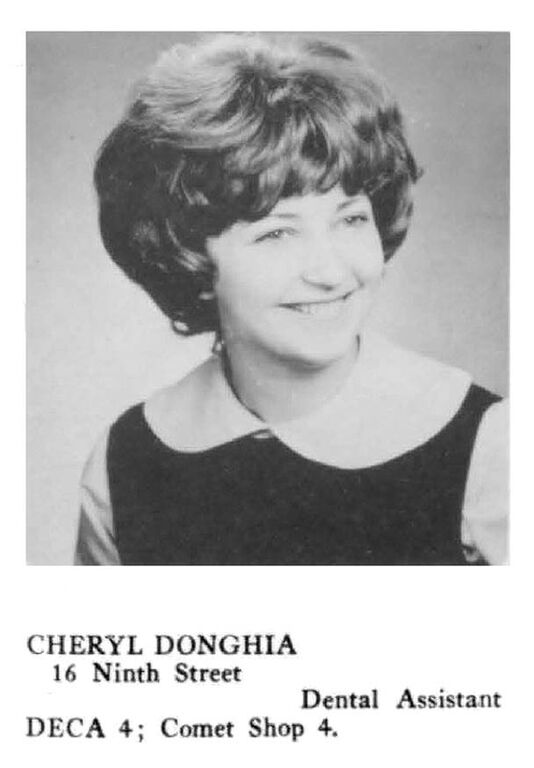
Alumni Meetup
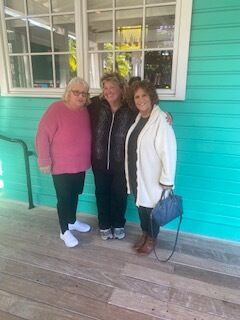
L-R Hope Cedar Dagan ('80), Jean Carlino Campbell ('80), and Stefanie Cedar Shames ('77) met in Orlando, Florida, in December 2025.
The following comments on various articles have been recently posted by site members. Click on a title if you want to read the comment and/or join the discussion.