
 Introduction
When I was a student in Hicksville High, I didn’t know what to make of Principal Leon Galloway. My older sister Marilyn had known him as her teacher, and she spoke highly of him. She spoke highly in the same way about Raymond Rusch, whom I later knew as an Assistant Principal. When Mr. Rusch and I first met, he greeted me warmly and asked about Marilyn. In contrast, the few times that Mr. Galloway and I spoke seemed impersonal; he definitely did not exude warmth in my direction.
But in the 1990s, when I got involved with HixNews, I saw that other people (including Bob Casale) recalled him with warmth and gratitude. Obviously, there was a side of Mr. Galloway that I never got to see. Then more time went by, and as I researched Hicksville’s history, I sometimes would notice his name in old newspapers, in a context that surprised me. I finally decided to peek a little into the life of Leon J. Galloway, and this brief article is the result.
Note: I’ve tried something different in this article. In the Appendices, for each Source I list, I’ve categorized the information it provided. That may help readers who want look into things in greater detail.
Childhood and Catastrophe
Mr. Galloway was born on Christmas Day, 1902, to Philip and Anna Galloway. His parents had both been born in Pennsylvania, but by the time of the 1900 U.S. Census, they were living in Binghamton, New York, where Philip worked as a cobbler. In 1901, the Galloways had their first child, a boy name Glyn, but he died before the year was out. For reasons unknown to me, they were in Kentucky when Leon was born, although they returned to Binghamton afterwards.
Railroads were at the heart of America’s economy in that era, and Philip got an entry-level job at one of them as a brakeman, earning more money than a cobbler did. It was considered the most perilous job in railroading. Brakemen separated or coupled together freight cars, and they set or released the cars’ brakes. As the train moved along, they often had to cross from the roof of one swaying boxcar to the next, getting themselves into position to split the train between the right cars as it neared the next destination.
One February evening in 1906, Philip Galloway fell to his death from a train as he toiled in the railroad yards in Scranton, shown in this photograph from 1900. Look closely below the laundry hanging on the line, and you’ll see the silhouette of a man standing on a boxcar roof, with absolutely nothing to hold onto. That’s where brakemen spent most of their time.
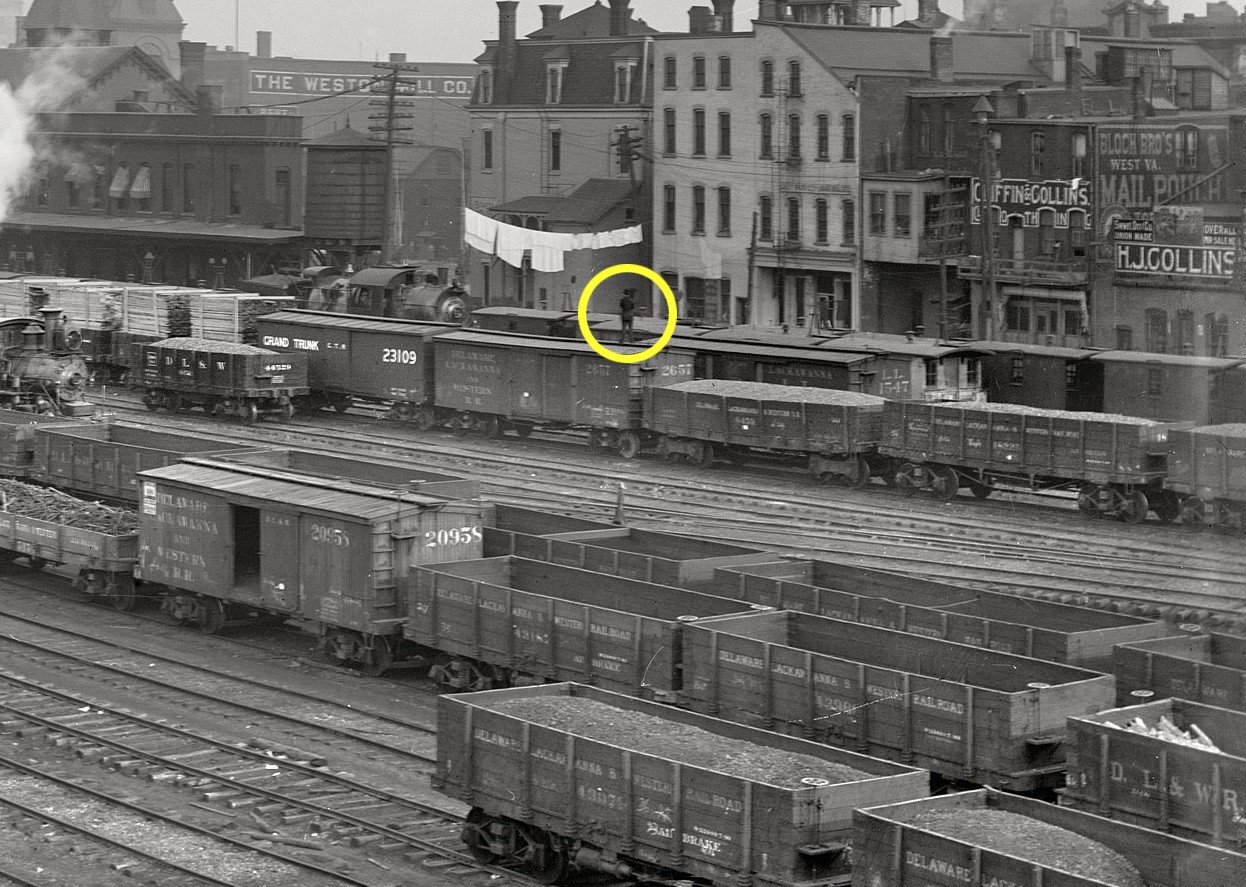 Why did Philip fall? Maybe his hands and feet were numb from the February cold. Or maybe he couldn’t see his footing clearly because February evenings got dark early. There could have been black ice on the roof. Maybe he was just plain tired, or maybe he had the flu. If a tired or sick brakeman stayed home, he wouldn’t be paid; he’d be fired.
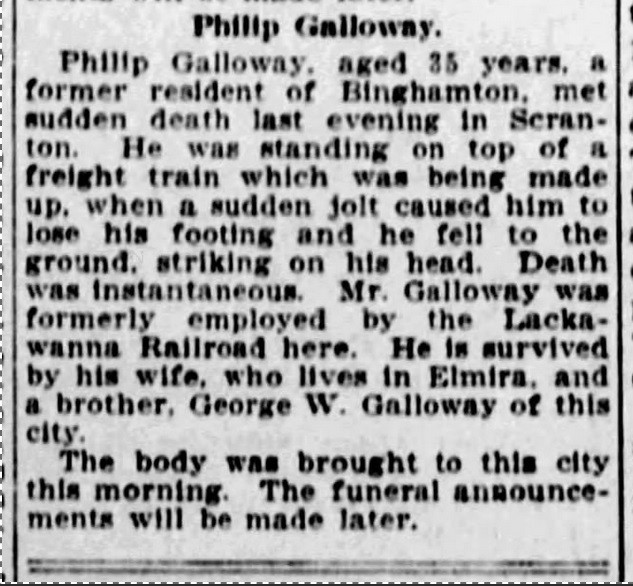 Although the newspaper report states that he died from the impact of a fall, his Death Certificate is more precise: Philip Galloway died because the train was moving when he fell, and it ran over him.
From Disadvantaged to Advantaged
Anna Galloway was pregnant when Philip died. Another son, Arnold, was born to her in 1906, but he died before the year was out. She never remarried; Leon grew up as an only child, raised by a mother whose avalanche of personal loss made the two of them exceptionally close. Like many other poor women, Anna worked in a cigar factory, and her pay would not have been high. It appears that the family’s financial difficulties were well known; even the 1921 yearbook from Binghamton Central High School seems to allude to them.
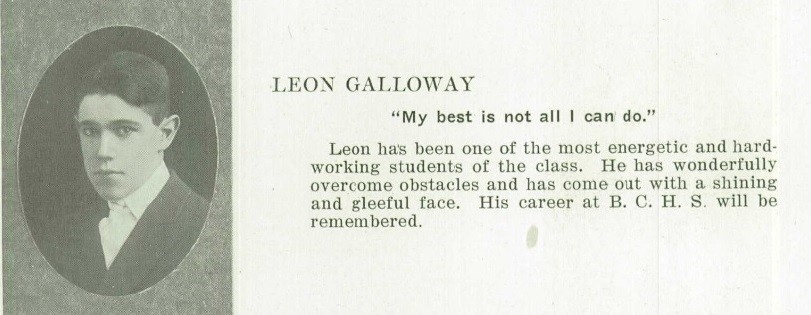 Well, maybe his face wasn’t ALWAYS shining and gleeful. Nonetheless, Leon Galloway was a brilliant student. He went on to graduate from Syracuse University, earn a Masters at Columbia, and later in life, earn a Doctorate.
At Syracuse, his abilities were recognized by his being named to Alpha Kappa Psi, an elite business fraternity, whose members have included the heads of some of the largest multinational American businesses, as well as powerful politicians (including U.S. Presidents). Being a member would help open doors for Leon, even in “the sticks” of 1930s Hicksville. He would have access to many local businessmen and government officials, especially those who were members of the Kiwanis service organization, as he was.
Paying It Forward
Like his predecessor Mabel Farley, Galloway seemed to devote as much unpaid time to volunteering as he did to his paid job as an educator.
For understandable reasons, his volunteer work often focused on youth who were at risk due to circumstance, such as summer camps or swim excursions for orphans, or for children of impoverished families. For that matter, the somewhat rough-and-tumble crew that everyone at HHS called “Galloway’s Boys ” may have come about because of his desire to help youth who were not fitting in socially, and thus were putting themselves at risk.
Galloway also volunteered in social arenas other than needy youth. Like Farley, he served on the Hicksville Public Library’s Board of Trustees, through which the library offered lectures that informed Hicksvillians of government and social developments that affected them. These lectures explained a wide range of topics, from the introduction of Social Security, to a review of how air travel was making distant vacation spots more accessible.
Still together through Galloway’s most active years in Hicksville, Leon and his mother shared a dwelling and often vacationed together. Anna Galloway died in 1966, and the following year her son finally felt free to marry, so he did. He passed away late in 1985. He is buried in a family plot in Broome County, New York, along with his parents and the siblings who died in infancy.
May he rest in Peace.
Appendix: Sources of Information
- 1900 U.S. Census and 1910 U.S. Census
- personal data for Anna and Leon Galloway, including Anna’s work making cigars
- Findagrave.com
- data on Leon Galloway’s siblings; mention of his earning a PhD;
- death date of his mother Anna
- 1905 New York State Census
- data about Leon’s parents
- Commonwealth of Pennsylvania Death Certificate for Philip Galloway
- details of his death
- 1926 Onandagan, Syracuse University Yearbook
- Leon’s election to Alpha Kappa Psi
- Brooklyn Eagle for June 1. 1932
- Leon receives his Masters degree
- Various newspapers in greater NYC and in the Susquehanna Valley
- reports on community service work undertaken by Farley and/or Galloway
- New York State Marriage Index
- 1967 marriage of Leon J. Galloway to Harriet Phillips Pill
- Social Security Index of Deaths
- Date of Death for Leon Galloway
Appendix: Sources for Images
- Leon J. Galloway Leading HHS Students
- 1964 Comet Yearbook
- 1900 view of Lackawanna rail yards in Scranton (excerpt, highlight added by author)
- Shorpy American Historical Photo Archive
- Report of Philip Galloway’s Death
- Binghamton News, February 9, 1906
- Yearbook Picture
- 1921 Panorama Yearbook, Binghamton Central High School